Scientific mind, faithful spirit
Biology’s Dr. Josh Owens puts students first in his faith walk and in his scientific pursuit to fight cancer.
Posted 5/29/26
For Associate Professor Dr. Josh Owens (BS ’16), biology at Lipscomb is a very personal pursuit.
It’s true that he is a respected scientific researcher who has helped discover a new molecule, won awards from the National Cancer Institute, has been published in academic journals many times over and will soon become a published book author, but he came back to Lipscomb in 2021 for reasons far deeper than intellectual recognition.
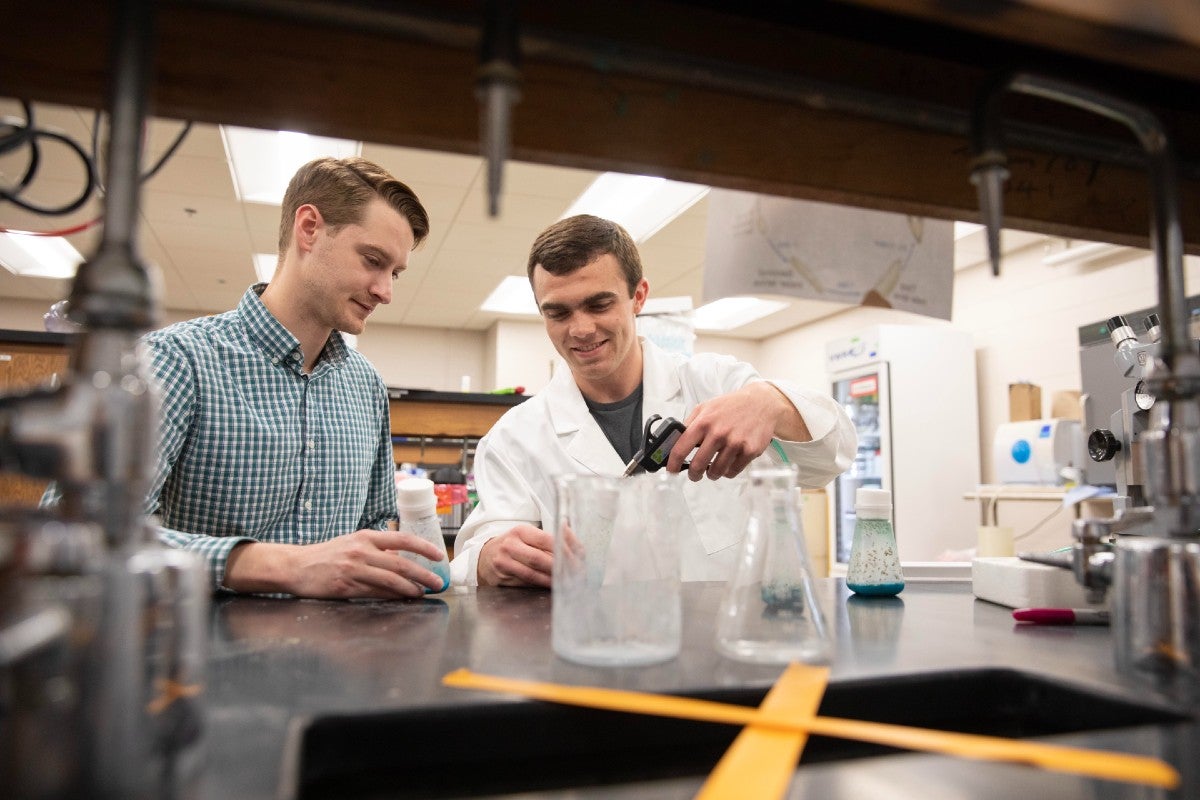
“How I view research at Lipscomb, is that it is really fun to ask interesting questions and pursue interesting angles even if it doesn’t make a huge immediate impact in the research world,” said Owens, who has 15 or more students carrying out experiments in his lab every semester because, he admits, he has a hard time saying no to any student excited to learn.
“For me it is about being a really good mentor and having the students excited about doing research,” said Owens, who is also Lipscomb’s undergraduate research coordinator in STEM.
He is proud of the fact that 100% of the students he has mentored at Lipscomb so far have been accepted into medical school, and he is hopeful that within a year his research into the effects of the microbiome and metabolism on obesity and cancer will be accepted for publication and at least eight Lipscomb students will be listed among the authors.
On top of his love for students, Owens has deep roots with Lipscomb’s biology program, as his grandfather, Dr. Willis Owens (BA ’53) taught biology and genetics at Lipscomb for almost 40 years until 1990, training several of the professors who came to be mentors for his grandson.
Teaching in the same halls and classrooms in McFarland Science Center where his grandfather taught is a privilege that Josh Owens does not take lightly.
After earning his bachelor’s degree from Lipscomb, Josh pursued his Ph.D. in immunology at Emory University in Atlanta and was weighing job offers from the Centers for Disease Control and a biotech firm in California when his former mentor, now-biology department Chair Dr. Jon Lowrance (BS ’77) contacted him about an open position at Lipscomb.
“When God calls you, you have to respond, and I feel like this was a direct call,” Owens said of his move to teach at Lipscomb instead of more high-profile offers.
Arriving on campus, he found his office in the McFarland Center, the same building his grandfather saw built from the ground up in the 1960s.
Discovering new possibilities to fight cancer
Owens brought some impressive scientific skills with him to the Lipscomb faculty. During his time at Emory, he was awarded the Ruth L. Kirschstein National Research Service Award by the National Cancer Institute and published 17 peer-reviewed articles on topics including cancer immunology, the microbiome, fat metabolism and Covid-19.
He jumped right in at Lipscomb to continue research spawned by his Ph.D. research at Emory. As part of a team led by Dr. Ken Lui, Owens helped lead a joint discovery of a novel microbially produced molecule, delta-Valerobetaine (VB), that comes from bacteria in the gut and prevents the burning of fat. This discovery was the cover story of the journal Nature Metabolism when it was published.
At Lipscomb, Owens is exploring if VB can be used to maximize treatments for cancer by cutting off one of the disease’s energy supplies: fat. Cancer can use the energy from burning fats to spread and metastasize faster. Owens’ hypothesis is that VB, which prevents fat burning, may be able to starve cancer of that fuel source, weakening the cancer cells and making them more susceptible to chemotherapy and other cancer treatments.
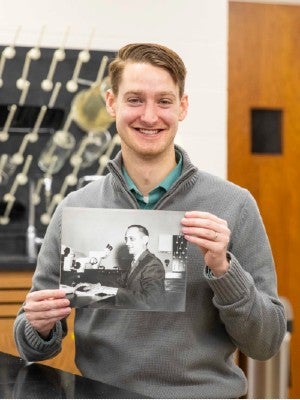
Owens with a photo of his grandfather Willis Owens
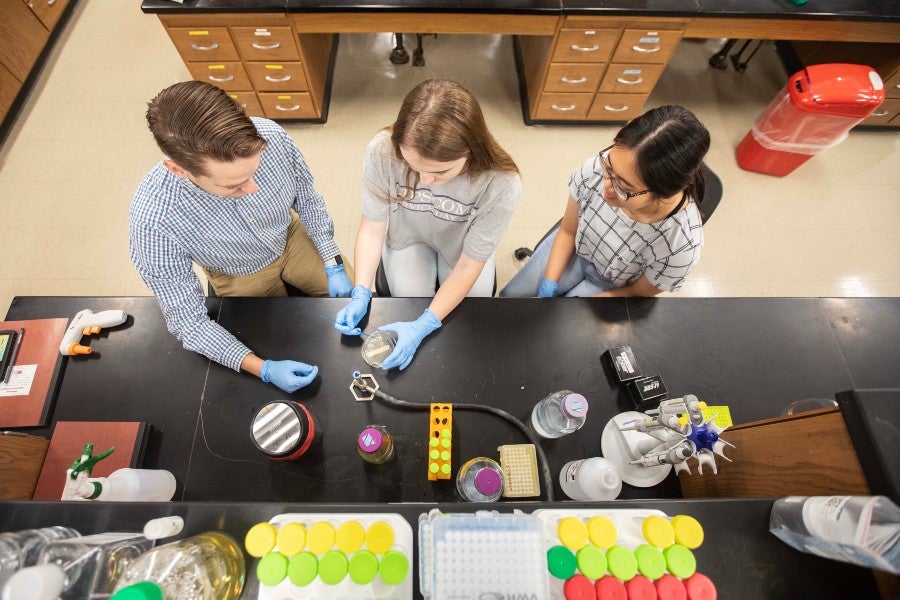
Over his years at Lipscomb, with students running all of his hands-on, in-lab experiments, Owens had demonstrated that VB can break the cycle of cancer using fat energy, thus weakening the cancer cells’ ability to migrate, divide and proliferate, he said.
This summer, he will be overseeing three Langford-Yates Scholar students, Thomas Manaye, Lydia Waldrop and Cathy Youssef, who will conduct the final experiments to observe VB behavior before he submits his latest findings for publication this summer or fall.
Since 2021, Owens has won a Lipscomb Faculty Summer grant and a Christian Scholars’ Foundation Junior Faculty Grant to continue his research. Since 2024, Owens has also been awarded for his student-centric teaching and mentoring, earning Lipscomb’s Cowart Excellence in STEM award and Outstanding Teacher of the Year.
Discovering today’s faith/science mindset
As both a scientist and a lifelong Christian, Owens harbors a deep interest in exploring the dichotomy of faith and science, and is actively working to help students and the Christian community to navigate that complex intersection in a godly way.
He has been a leader in conducting research on today’s perceptions of faith and science both on-campus and in the region, and on the personal side, he has written a book about life in the Holy Spirit which has been contracted to be published by Wipf and Stock.
“As college professors and administrators at faith-based institutions, we are committed to helping our students learn how to remain rooted in their faith while pursuing high-level academics,” says Owens. “We want to remove any perceived stumbling blocks for students who are capable of making an impact in their fields but fear they must abandon their faith in order to engage in relevant academic discussions.”
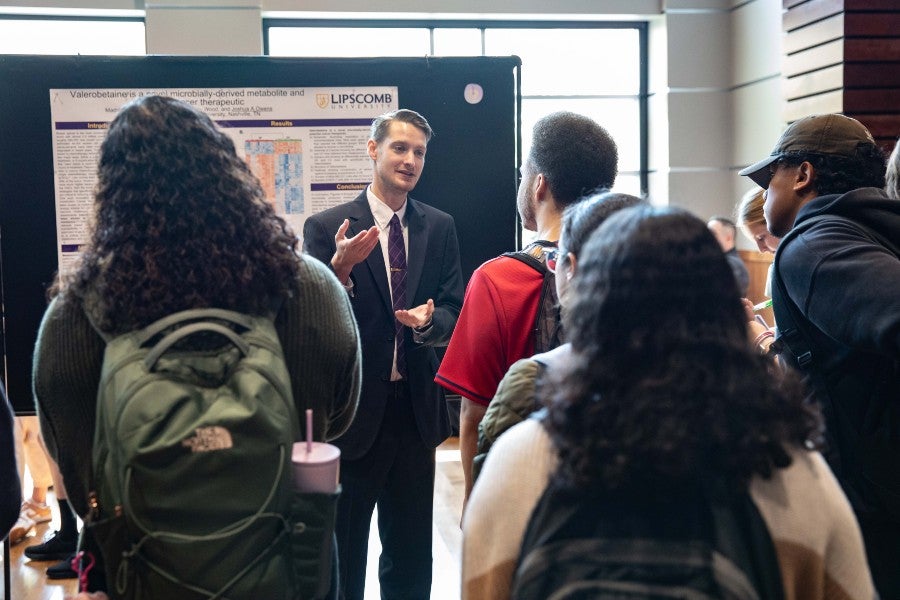
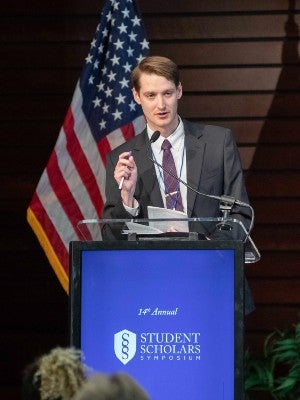
Josh Owens sharing his research with students at the annual Faculty Research day. Owens is Lipscomb’s undergraduate research coordinator in STEM.
He personally experienced such stumbling blocks during his studies in graduate school. During an interview, Owens was told, “Christianity is only followed by those who are intellectually weak.”
At that moment, he had the confidence to reply that he was a Christian because he knew that his faith did not equate to being academically bankrupt as that professor implied. However, he says that he is haunted by the fact that many individuals do not believe that you can be both a Christian and a scientist.
Owens has worked with Lipscomb’s McClure Center for Faith and Science to carry out two grant-funded projects: a study of college freshmen’s perceptions of faith and science, surveying students at Lipscomb, Belmont and Samford universities; and a workshop to equip ministers to engage their congregations in conversations about faith and science, exploring biblical interpretations alongside scientific perspectives on Scripture.
In his own faith and science research, carried out with the help of students over the past few years, Owens is exploring viewpoints amongst ministers in the South, believing them to be highly influential on the beliefs of young people entering college today.
Owens believes that national surveys on Americans’ perspectives of faith and science, tend to under-value the impact that ministers have on their congregants and to under-count Southern rural areas, he said. So a few years ago he began a survey of ministers, starting with rural churches of Christ in Tennessee and Alabama, to find out just what that population believes on the subject.
“What the results of almost 200 responses have revealed is that while ministers broadly affirm compatibility between faith and science, there's often more complexity in how they engage with specific scientific concepts—highlighting an opportunity for deeper dialogue and resources. To that end, the McClure Center remains a space for open dialogue on faith and science,” says Owens.
In his most recent work, he has expanded the survey to other Christian faith groups (i.e. Southern Baptist and Methodist) and is working to obtain another 150 responses to shore up his findings to submit the work for publication.
Discovering life in the Spirit
Whether guiding students through bench research in the biology lab or emailing ministers throughout the Southeast, Owens is passionate about the mission of Lipscomb and desires to be an advocate for his students, so when he turned his mind toward writing a book, he decided that the best way he could influence others was to share how God has shaped his own life through the Holy Spirit.
“I wrote the book for myself, because I didn’t really understand the Holy Spirit growing up,” said Owens, who was raised in a Christian home. “It is a journey into the Spirit-led life. It’s exploring the idea that we can experience God in every moment and everything we do, that we can recognize that we are not walking this walk alone, and in our joy and suffering the Spirit is there with us and pulling us toward the Father and the Son.”
Even while juggling so many projects and a growing family, Owens’ “main focus is always on students,” he said. “I want them to have a good experience in the lab, to learn how to ask good questions, to dive deep and to become experts in their own right. Winning awards and being published is just the cherry on top of the cake.”