Leave room for inspiration
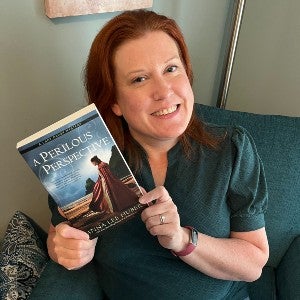
Author Anna Lee Huber likes a little mystery in her life, much to the joy of millions of readers who enjoy the USA Today-bestselling novelist’s historical mystery series.

Photo by Danielle Morales
Anna Lee Huber (BA ’02) likes a plan. But she also saves a little room for inspiration.
She certainly arrived at Lipscomb University as a freshman with a plan: to become the next Amy Grant, queen of contemporary Christian music.
But when that didn’t pan out, she rekindled the creative spirit of her youth and launched a new plan. And how did that turn out? Here’s a clue…
Today she has written 25 novels including three historical mystery series, one historical fiction novel about the Titanic; and one novella in an anthology.
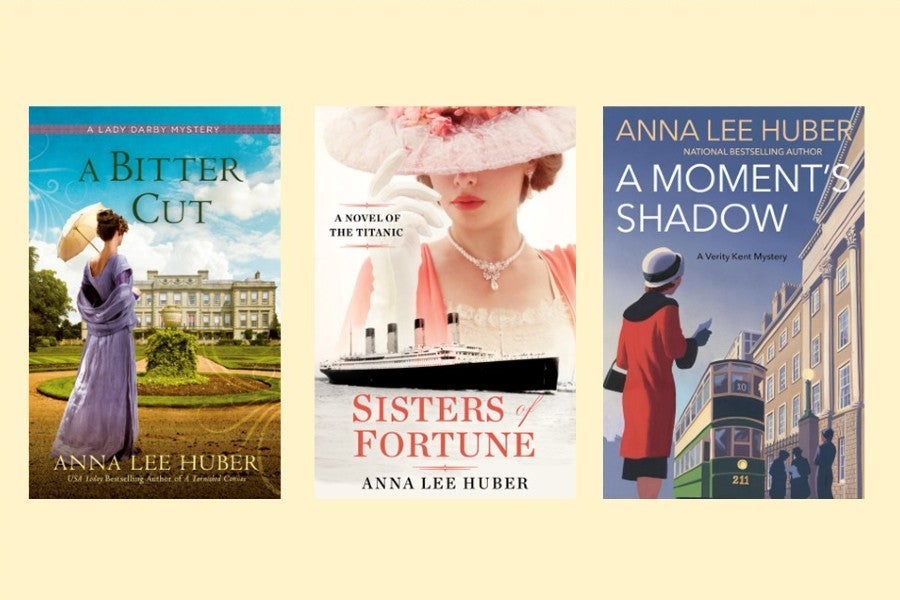
The Lady Darby Mysteries follows Kiera Darby, an artistic sleuth in 1830s Scotland, as she uses her knowledge of anatomy and art to solve murders. The Verity Kent Mysteries follow a war widow and former British Secret Service agent as she navigates post-World War I intrigue and murder mysteries.
Two more are on the way in 2026: A Bitter Cut, the 14th Lady Darby novel, in June and The Bravest Hour, the ninth Verity Kent novel, in August.
“I try to leave things open as much as I can,” to allow for inspiration, said Huber, who now lives in Indiana with her two daughters and Lipscomb alumni husband, Shanon Aycock (BA ’01). “You do need to give depth to your characters and understand who they are, but it's also really nice to leave that mystery—not only for yourself, but for your readers.”
In fact, she intentionally doesn’t write the name of the murderer in concrete before finishing a book, just to leave that mystery open.
“I think, for me, it forces me to make it more interesting and trickier, because if I'm giving clues that could point to multiple people, it helps avoid the tendency to make it too obvious for the reader. By making myself come up with different paths, that hopefully makes it trickier all around.”
Huber’s path to become a published writer was a little tricky in itself.
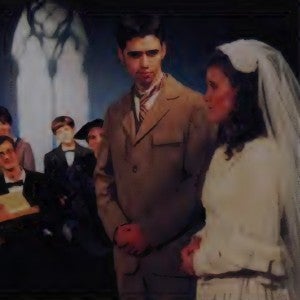
Huber in the 2000 production of Our Town
She chose Lipscomb because of her love of music. Music City USA sounded perfect for a young Huber with ambitions to go into contemporary Christian music. She spent four years studying classical music with former adjunct faculty member Patricia Roberts, and counted her among her mentors as she tried to navigate the music business.
During college she performed in the Early Music Consort and the Jazz Vocal Ensemble, both directed by the late Gerald Moore and the A Capella Singers, directed by Larry Griffith.
She also performed in theatre, portraying the lead role of Emily Webb in the 2000 production of Our Town, directed by Deb Holloway. Her future husband played the drunken choirmaster in the production, where the two met.
Upon graduation, she found the music business tougher to break into than she anticipated, and with a husband and an uninspiring administrative assistant job in Nashville, she returned to her childhood love of reading mystery novels as a personal creative outlet.
Her hobby reminded her of how much she had enjoyed writing as a youth. At 10 years old, she penned her first story, "Prom Duty," and asked her teacher to read it to the class. She went on to write several more stories, including a series featuring her own gang of mystery-solving teens, inspired by Nancy Drew novels.
“I tell people that if you like Jane Austin and Bridgerton, you will like Lady Darby, and if you like Agatha Christie and Downton Abbey, you will like Verity Kent,” said Huber. — Anna Lee Huber
Remembering those early creations, Huber decided to devote one holiday weekend to doing nothing but researching and writing her own novel—just for fun.
“The bug bit me, and I never looked back. I decided right then and there that writing was what I was going to pursue, no matter what else I did,” said Huber, “and so I've been writing ever since.”
And that she did, writing four different novels over seven years before her fifth, The Anatomist’s Wife, was picked up by an agent and published in 2013 by Penguin Random House.
Besides writing and music, Huber also loved history as she grew up, so when she began writing as an adult, she was immediately drawn to historical fiction mixed with romance and mystery. “I loved the music history course at Lipscomb, and my classmates thought I was crazy!” she laughs.
“My first (unpublished) book was historical, and then I tried to write romance, but I kept having dead bodies show up. So I finally decided to write a mystery with a romance subplot,” chuckled Huber.
Huber chose to set her books in environs on the British Isle in the 1830s because she found that there was not much historical fiction set in this time period when William IV ruled. Sandwiched between the Regency era and the Victorian era, these years don’t get a lot of attention in fiction, she said.
“I started doing research, and it just fit so perfectly with what my character was and her background,” Huber said of Lady Darby, a widowed artist shunned by polite society because of her role helping her late husband during autopsies.
In researching the World War I era for an idea for a second mystery series, Huber “stumbled across the British intelligence MI6 website and learned that there were all these women who spied for British intelligence during World War I. So that was my in with the Verity Kent series—making her a former intelligence agent.”
Today, she conducts in-depth research for all her books and loves it so much, she sometimes has to pry herself away from the research to write.
“If you want to write history, you have to really love it, otherwise it would be torture. I could dive down rabbit holes all day long. I love to learn anything,” said Huber, who keeps a notebook of ideas constantly in the works.
Only about 10 to 15% of her research ends up in any particular book, but much like her classical music studies at Lipscomb, 100% of the research and knowledge ends up informing each book she writes, she says.
“Everything you learn you end up using. It all builds on itself. A lot of my characters have artistic sensibilities, and language itself is like a different type of music,” said Huber, who says she turns to etymology dictionaries all the time.
“In different eras, people speak differently. I imagine the music they listened to at that time, and how that impacts how they form their sentences. The 1920s has a lot of slang and a different rhythm and beat to the words… I love finding old turns of phrase and metaphors that we today can relate to, but they have fallen out of use.”
She never falls short of ideas, she says. “I feel like I have so many ideas, that I don’t have enough time in life to write all of them. Everything is fodder. I get ideas from the weirdest and wackiest places.”
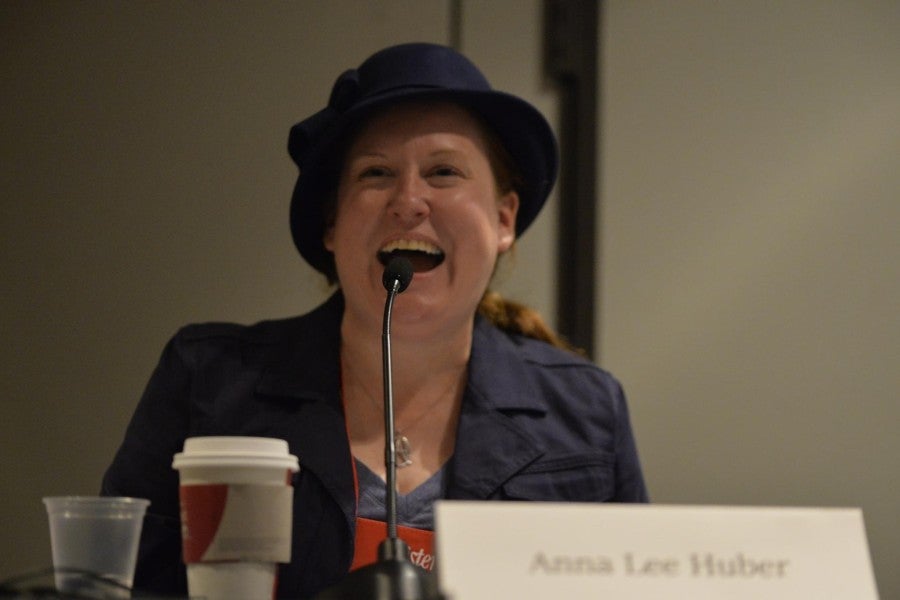
Today, Huber uses her music skills as director of the children’s choir at Covenant United Methodist Church, and spends a lot of time on the Internet (www.annaleehuber.com) and social media interacting with her readers. Her blog often gives readers sneak peaks into the research she is conducting for her next books. Her website lists her book signing events and opportunities for readers to win free copies of her books.
With everything Huber has learned over the years about the publishing business, her key advice for young writers is the same advice she got from a mentor early on: just finish the book. Even if you don’t like it or don’t think it will sell, just be sure to actually finish any book you write. The experience of planning, researching and writing through the entire process will serve future writers well, she said.
“I wish I had known in the beginning to not panic. Know that this is a journey,” said Huber. “It's going to be a slow build. I feel like that when you are first starting out, you just want it all, and you want it all immediately.
“But now I tell people, be strategic with your time and resources. I knew the things I could control, in my situation, were how much I could write, and so I made it my goal to just write as much as I could. That was great advice.”