Students publish Lippy Robotics' latest work in AI learning for robots
Five engineering students' work with deep reinforcement learning for robots featured in academic journal and international conference.
By Janel Shoun-Smith |
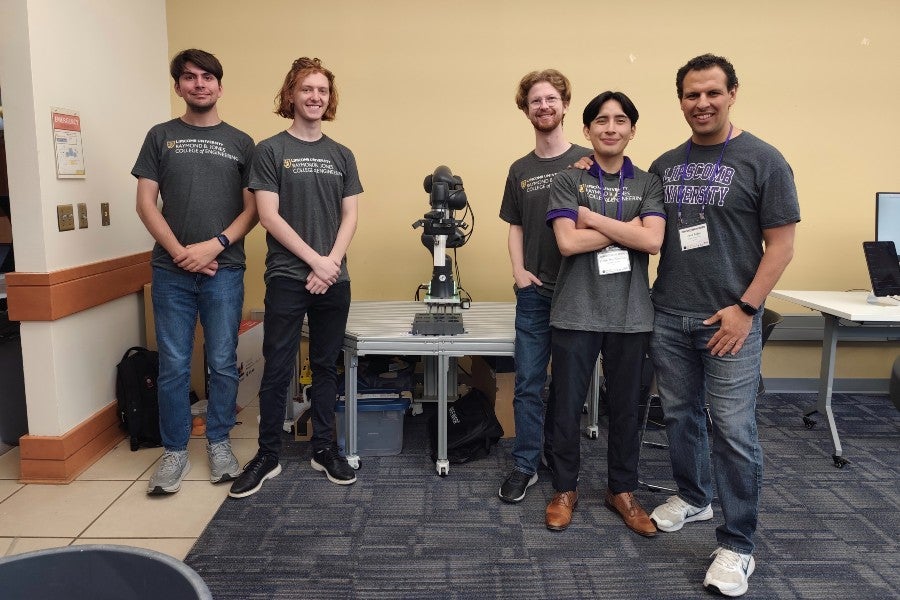
As part of Lipscomb’s rapidly growing undergraduate track in robotics engineering, four students were listed as authors on a recent article in Frontiers in Artificial Intelligence (AI), a multi-disciplinary, open access journal that publishes peer-reviewed research on the development and real-world application of AI technologies.
Ryan Vanderstelt, Cleiver Ruiz-Martinez, Blake Hull and Caeden Rosen were listed as authors along with their advisor on the project Dr. Juan Rojas, assistant professor of electrical and computer engineering.
Through his in-class and summer research with students, at the LippyRobotics Undergraduate Research Lab, Rojas is using concepts of branched symmetries in computer coding, allowing the robot to replicate its past experience with a task many times over and in many different ways, without actually physically doing it that many times, to figure out how to make robots learn faster and learn from their mistakes on their own.
The article titled, "Exploring Deep Reinforcement Learning Acceleration by Superscaling Data Augmentation via Branched Fractal Symmetries," outlines the latest work Rojas and the students have done with Lipscomb’s state-of-the-art Franka Research Robot, a robot arm obtained in 2024 through a grant from the Louis R. Draughon Foundation.
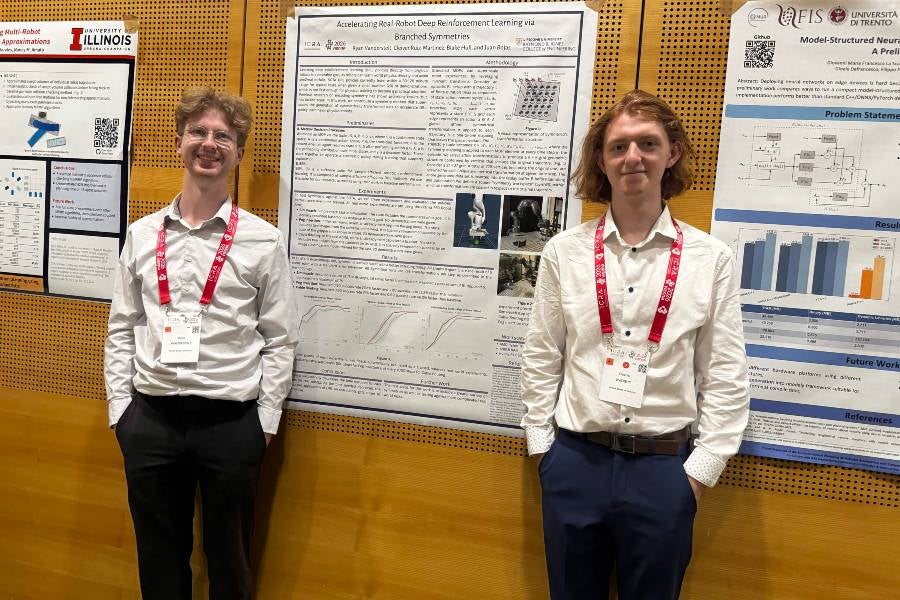
Vanderstelt and student Gabe Everett also traveled to Vienna, Austria, in June to present the same work on the project at the 2026 IEEE International Conference on Robotics and Automation’s (ICRA) RoboARCH: Robotics Acceleration with Computing Hardware and Systems Workshop. According to Google Scholars metrics, ICRA is the premiere conference on robotics research around the world.
Everett and student Brice Gunter are taking up the continuation of the project as part of the 10-person student crew working with Rojas this summer to not only advance the deep reinforcement learning project but to also build an upper torso humanoid robot from scratch and other projects.
Benefitting the Lippy Robotics program this summer are a $15,000 Open Research Catalyst Award (ORCA), advancing open-research in robotics; a NASA grant and fellowship for Dr. Rojas; and an NVIDIA Academic Award that includes an RTX PRO 6000 GPU for faster computing.