NFL Chief Medical Officer speaks to students
Dr. Allen K. Sills discusses how the scientific process has brought greater safety and wellness to professional football players.
By Janel Shoun-Smith | 615-966-7078 |
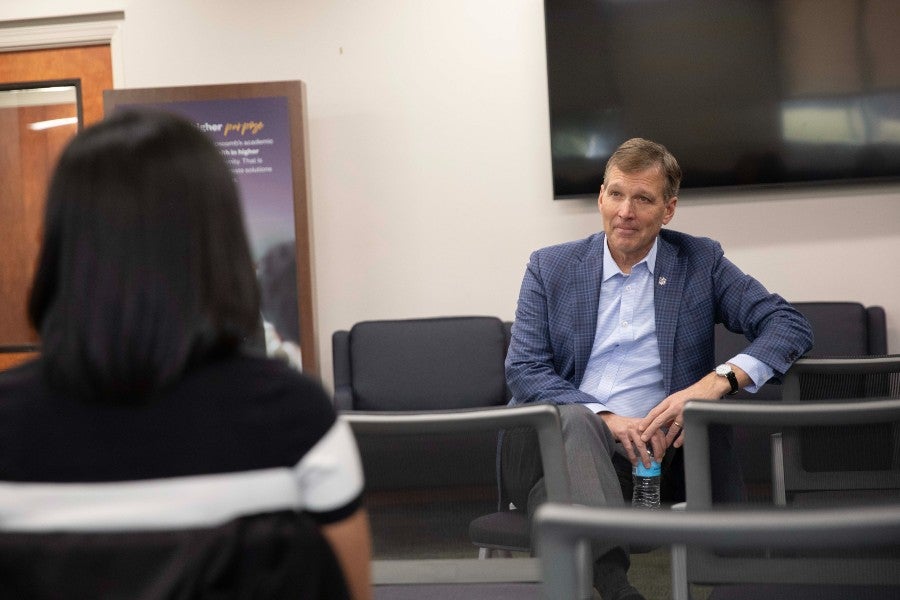
Science-focused students received a rare opportunity this month as Dr. Allen K. Sills, the NFL's Chief Medical Officer (CMO) and the founder and co-director of the Vanderbilt Sports Concussion Center, visited campus as part of the Physician-in-Residence speaker series.
Sills discussed everything from helmet testing to the 2024 new kick-off rule, from the need for the blue medical tent on the sidelines to changes in player attitudes over the years, making it clear how the scientific process and the expansion of health professionals in the NFL has brought a new level of safety and wellness to players.
Since 2021, the J.S. Ward Society, an initiative to support pre-health professions students, has invited local health care professionals to speak with students, both formally and informally, each semester in the Physician-in-Residence series, with a goal to provide them with living models for connecting the sciences to the art of living.
Sills’ scientific connection to most people’s lives for 18 weeks of the year was very apparent as he described how the NFL’s health care team cares for players during each game, impacts rule decisions in the off-season using scientific data and has changed the behaviors of both players and coaches to prioritize safety and recognize its impact on creating a winning team.
“I can tell you that in one of the conference championship games a couple of weeks ago,” Sills told students in February, “one of the teams had a coach bring an important player over to the medical staff in the third quarter and say, ‘I think you need to check this player out. He doesn't seem right on the bench as I'm talking to him.’ That would have never happened 10 years ago, 20 years ago. It's a really, really neat cultural change where I think people are understanding why this is important.”
The NFL health team has been a big part of that cultural change, said Sills. “The NFL literally spends tens of millions of dollars every year on medical research, trying to better understand how to make the game safer through equipment and rules,” he said.
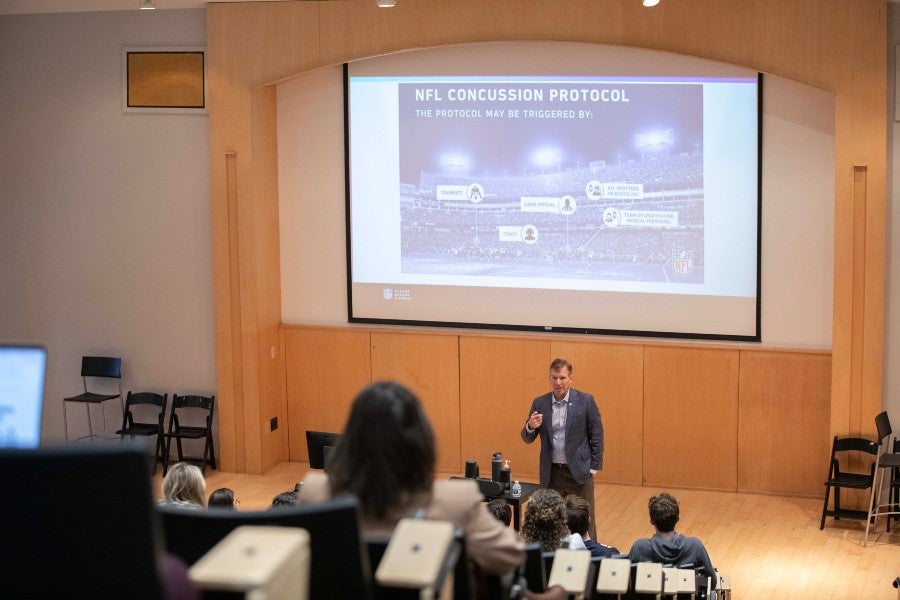
And that research becomes public, for all to see, he said, noting that a few years ago the NFL published its concussion protocol (questions asked and steps taken to diagnose a concussion during a game) both on its website and in peer-reviewed scientific literature. Also on its website is the NFL’s ranking of helmets recommended for safety, based on their own scientific stress tests, which go far beyond the pre-existing norm, Sills said.
The league made a major off-season push this past year to share the safety ranking of helmets with players who get to choose their own brand of helmet, coaches, owners and general managers, said Sills. As a result, 98% of NFL players wore helmets ranked among the safest, he said.
Sills has led the NFL's response to the COVID-19 pandemic, spearheaded the league's Injury Reduction Plan and is an active researcher, having published more than 170 scientific articles and presentations, including more than 40 in the last five years on the topic of sports concussion.
He is a member of the Concussion in Sport Group, which publishes international standards regarding concussion in sport.
Lipscomb students were able to hear Sills speak in Ward Hall and to interact with him one-on-one at an informal “office hours” time. Ward Society scholarship and fellowship winners attended a luncheon with Sills.
During his lecture for students, Sills described how the NFL medical team at each game includes athletics trainers, team doctors, independent doctors, orthopedists, spotters watching the game from the booth, neurotrauma consultants and experts on concussions, paramedics and an airway doctor.
Sills said he considers the NFL football field to be the safest place, after a hospital, to have a medical emergency. “We have all of the experts and the equipment there to deal with all of these medical and surgical emergencies, and our focus really on game day is making sure that we recognize and remove any player who might need medical care,” he said.
Sills said that one of his favorite parts of his job was the mountains of data the health teams has access to for research.
“We have game day reports from everybody who was there, we have a treasure trove of video... Every player wears a GPS tracking chip in their shoulder pads, so we know exactly how fast they are moving, where they are moving and where they are on the field in relation to other players. We also have tags in their helmet and their cleats,” he said. “We’ve got game participation data, environmental data and all 32 of our clubs report to the same electronic health record.
“That's hugely important for us, because we now have a comprehensive database of all these injuries and illnesses,” he said. “So we can take that data and combine it with data science from an epidemiology company and a bioengineering company who developed an analytics injury database that really helps us understand injury.”
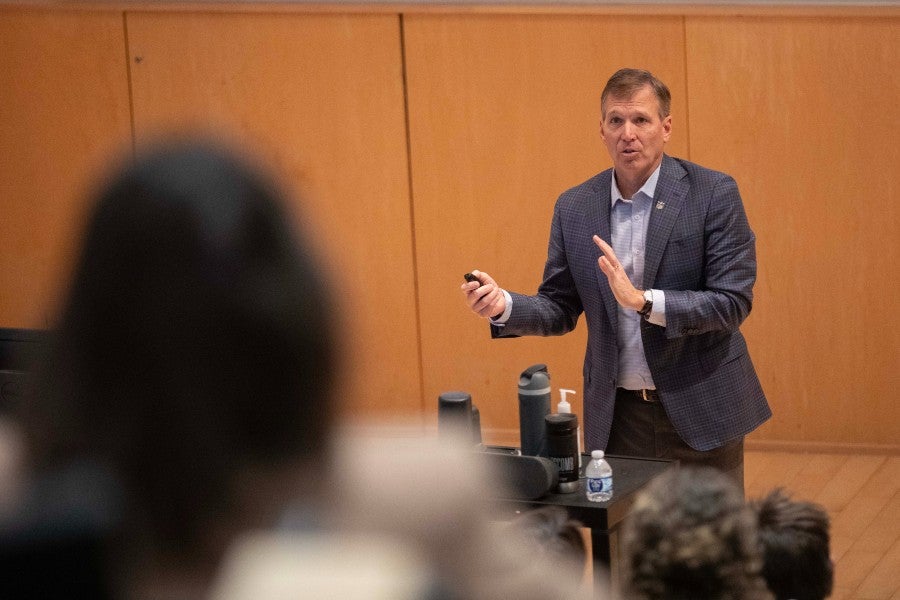
This data analysis showed the health team that the number one reason NFL players are kept off the field is lower extremity strains such as hamstring, calf or groin strains, said Sills.
This knowledge helped lead to the 2024 dynamic kick-off rule change, he said. The rule aimed to reduce injury rates and promote more kickoff returns by aligning players closer together and restricting their movement until the ball was touched.
“That change came out of our health and safety data, because the kickoff was our most risky play. There are more players injured on the kickoff than any other play,” he said.
“We've now got two seasons of data on this play, and I'll tell you just for this year, that we have a substantial increase in returns… Non-direct contact injuries went down substantially, 35 percent lower,” Sills said. Basically 20 of the 22 players on the field now have a lower injury rate. This is an illustration of how we can take our data and attack something that's injuring players.”
Other participants in Lipscomb’s Physician-in-Residence speaker series include health professionals Scott Guthrie (BA ’95), Alisa Bowersock (BS ’01), Eric Grogan (BS ’95), David LaVelle, Christian Matar (BS ’11), Luvell Glanton Jr. (BS ’97) and Kyle Stephens (BA ’02, MA ’04).