New partnership to broaden mental health safety net for students
Lipscomb has partnered with the JED Foundation to strengthen student mental health campuswide and amplify a culture of care.
Janel Shoun-Smith | 615-966-7078 |
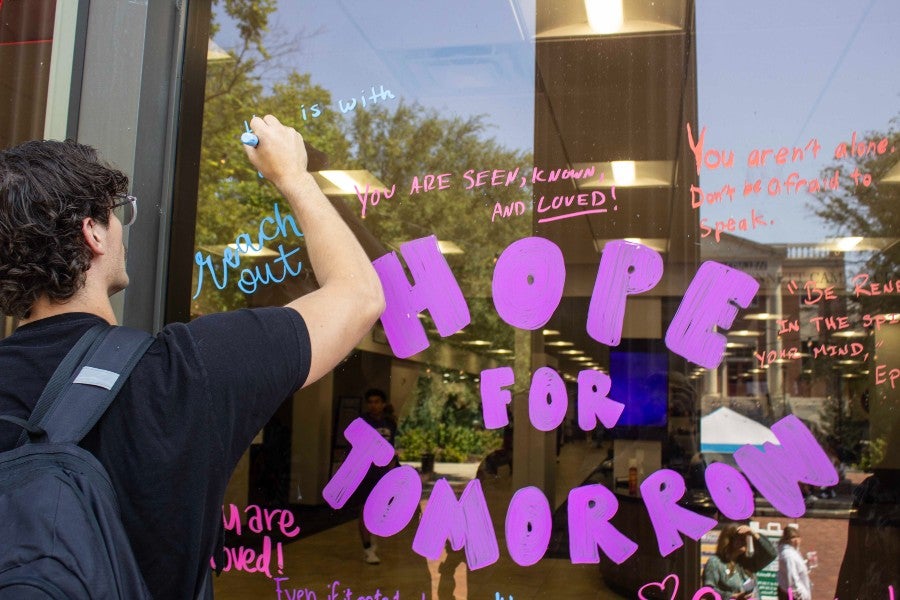
In a significant step toward enacting enhanced programs and services for student well-being and mental health, Lipscomb University has established a partnership with the JED Foundation, a leading nonprofit that helps schools evaluate and strengthen their mental health, substance misuse and suicide prevention programs.
Lipscomb is participating in an 18-month initiative to improve students' emotional well-being and mental health across the campus community. JED’s expert-led team helps assess the community’s needs and to develop a strategic plan.
Leveraging existing strengths, JED helps implement evidence-based, data driven recommended practices to create a connected campus community. The foundation’s JED Campus program seamlessly integrates with each university’s current systems to maximize impact without overwhelming staff.
Lipscomb’s involvement in this program was made possible by generous donors who value students’ mental health. The effort is led by the University Counseling Center and its director, Ashley Dumas, but involves various departments and services throughout campus.
“Student mental health is everybody's responsibility. It's far too big of an issue to be confined within the Counseling Center,” said Dumas. “We all play different roles in supporting our students and their mental health, and that role just looks a little different depending on our specific function at the university.”

Lipscomb began its partnership with the JED Foundation in February 2025, with the first step being the establishment of a JED Campus Team representing diverse areas of campus from the Office of Student Life, Risk Management, the Learning Commons, Health Services, Security and Safety, Athletics, Office of the President, Office of Strategic Planning, Communications/Marketing and faculty.
The process has also been informed by the JED Foundation’s Healthy Minds Survey, administered to students earlier in 2025.
The JED Campus Team completed a baseline assessment of eight key areas: strategic planning, life skills, social connectedness, identifying students at risk, help-seeking, clinical services, substance misuse, and crisis and means.
Lipscomb hosted a two-day site visit for JED officials that included a campus tour, insight from a student focus group, a student wellness meeting and an all-day JED team meeting.
The JED Campus Team has looked closely at areas such as training for faculty who are on the front lines with students every day, aspects of facilities that enhance risk such as roof access or chemical storage in science labs; signage and communication about needed resources; and leave policies, among many other factors, said Dumas.
“JED provides feedback regarding campus strengths as well as areas of need. Then Lipscomb and JED work hand-in-hand to create an individualized strategic plan and JED provides support to implement that plan,” she said.

Currently, Lipscomb’s Counseling Center provides quality clinical services, crisis intervention, preventative mental health initiatives and access to community resources at no cost to students.
In addition, the student success and wellbeing office promotes holistic health and student wellbeing of campus through intentional programming, education and one-on-one relationship development. That office oversees student care coordination, Care Teams and new student orientation programs.
Over the next few months, the JED Campus program will further enhance these existing best practices into a comprehensive mental health strategy that protects students and strengthens the entire educational community at Lipscomb, said Dumas.
The JED Foundation, founded in 2000 by a family who lost their son, Jed, to suicide in 1998, is a nonprofit that protects emotional health and prevents suicide among teens and young adults.
JED has partnered with more than 550 higher education institutions, 150 high schools and 20 school districts representing more than 400 schools (a total of more than 7.4 million youth) on evidence-based mental health programs that lower suicide risk, strengthen schools and communities and foster emotional wellbeing.