May trip to Italy highlights connections between art and health science
New travel course offers nursing students a convenient way to fit global learning into their academic schedule.
Janel Shoun-Smith | 615-966-7078 |
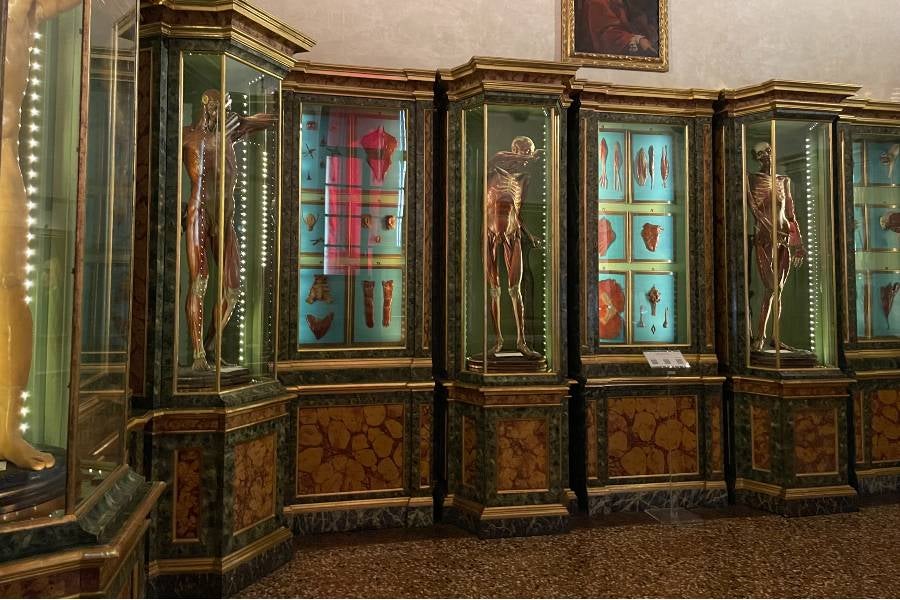
Examples of early anatomy models used for medical education in the Museo di Palazzo Poggi in Bologna, Italy.
Lipscomb nursing and biology students have a new opportunity this spring to combine health sciences with global learning and the arts, through the short-term travel course The Art of Anatomy, Culture, and Healthcare, to be held in Italy this May.
Twelve biology and nursing students have signed up to participate in the two-week trip, where students will learn about the connections between art and anatomy. The trip offers a rare opportunity for nursing students to be able to incorporate global travel into their rigorous course load.
Often nursing students who wish to participate in global travel either bring college credits into their freshman year from high school or enroll for an extra semester to enjoy the valuable experience, said Jill Stafford, assistant professor in the School of Nursing and co-director of the trip.
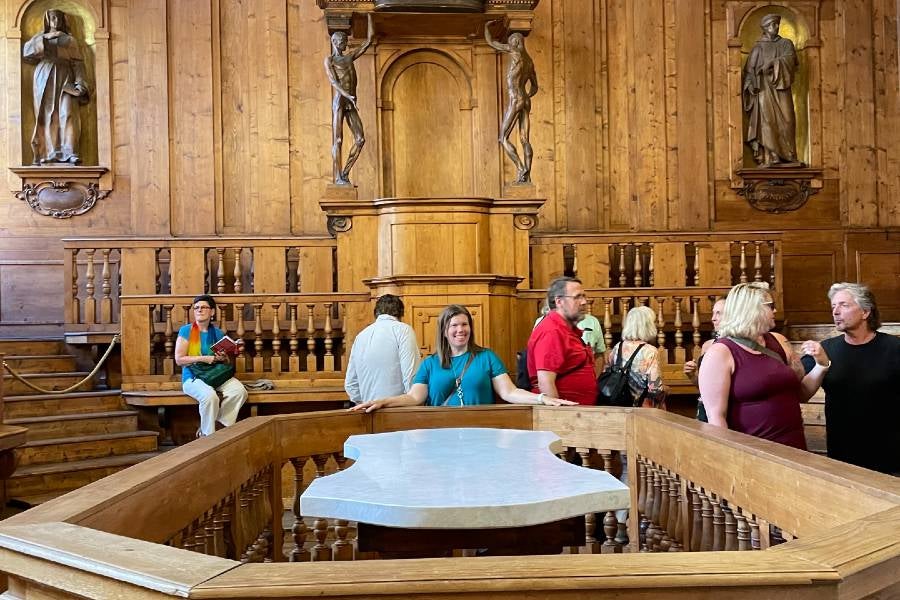
Jill Kirby, associate professor in biology and co-leader of the trip, poses in the Anatomical Theatre of Archiginnasio at the University of Bologna, one of the sites the students will visit in May.
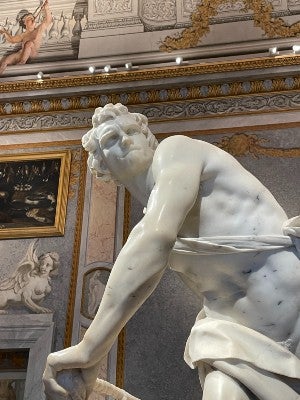
Michelangelo's 'David,' a site on the trip
The Art of Anatomy, Culture, and Healthcare course not only serves as a nursing elective for Lipscomb nursing students, but it also allows them to fit global travel more conveniently into a four-year track for their undergraduate studies, she said.
“Faith, and history have shaped what we carry out as today’s best nursing practice, and a lot of that has emerged from other cultures,” said Stafford. “We hope this trip will make student nurses more well-rounded, culturally sensitive practitioners. In addition, touring current Italian hospitals will allow them to see similarities and contrasts with their own clinical experiences in Tennessee.”
Belinda Asamoah, an avid art lover and senior nursing student from Ghana, said the opportunity seems tailor-made for students who, like her, love philosophy, art and cultural studies.
“As a nursing student, our curriculum is understandably science-heavy, and there aren’t many opportunities to engage creatively through art,” said Asamoah. “Likewise, if I had pursued art academically, I would have had to step away from healthcare. This course beautifully bridges both worlds. It feels like the perfect space for me to grow academically and personally, bringing together creativity, science and culture in one experience.”
“Experiencing other cultures and lifestyles is something hugely beneficial to nurses as we constantly take on a posture of curiosity when engaging with and caring for our patients,” said Carsyn Wharton, a senior nursing student from West Virginia. “I look forward to the opportunity to further learn how to ask great questions and be curious about other ways of life through our experience abroad in Italy.”
Stafford is co-directing the trip with Jill Kirby, associate professor in biology and senior executive director of Lipscomb’s Learning Commons. The pair plan to hold the travel course every other year.
I am hoping to gain a better grasp on the history of anatomy and physiology where education on the human body all began and what it looked like for students years ago to learn and study. — Carsyn Wharton, nursing senior
Kirby discovered the concept for the trip in 2019 at an academic conference. She received a Lipscomb University grant to travel to Florence in 2022 to participate in an art and anatomy trip designed to show college faculty how to carry out such a learning opportunity for their own students.
The co-biology and nursing course utilizes Lipscomb’s villa in Florence as a home base for students as they study the history of art and how it has influenced anatomy and health care. Students also carry out online pre-travel assignments starting in March.
Students will visit two early dissection theaters, in Padua and Bologna, where public dissection was held for students during the transition from Medieval times to the Renaissance, when scholars began studying the actual make-up of the human body, said Kirby.
Also on the agenda are visits to churches and a viewing of the David sculpture by Michelangelo, who actually dissected bodies, said Kirby, to observe the accuracy of muscle placement, etc., on the human form.
“I want students to sharpen their observation skills, because in health care, noticing the small details can make all the difference,” she said.
In addition, students will visit Italian hospitals and hear a lecture by a health care professional about the hospital’s experience during the Covid-19 pandemic, which was particularly pervasive in Italy.
“There is a historical connection there that goes all the way back to the plague,” said Kirby. “I want students to reflect on how trust in the health care system has changed over time—and what lessons from the past can teach us about today.”
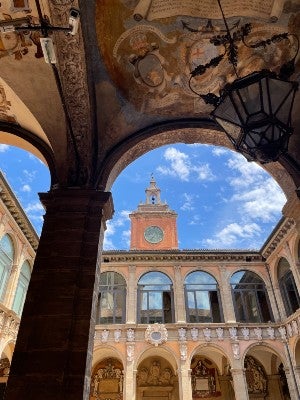
University of Bologna, a site on the trip
“I hope to explore global public health in the future, and experiences like this help build that foundation,” said Asamoah. “Seeing how healthcare operates outside of the United States and outside of my home country (Ghana) broadens my understanding of patient care, access and systems of support.
“Also, healthcare professionals serve diverse communities, and cultural awareness is essential to compassionate, effective care. A global learning experience strengthens adaptability, empathy and perspective, qualities that are critical in nursing. I believe this experience will shape how I approach healthcare, communication and advocacy throughout my career.”
Kirby hopes students will also make spiritual connections, especially at a site like the Capuchin Crypt in Rome, where monks have created art from the bones of their ancestors, in the crypts beneath the church of Santa Maria della Concezione dei Cappuccini.
“It really makes you confront your own mortality,” said Kirby of the experience. “But for us, we know that we are not just bones. Our lives have meaning beyond what we see.”
“This trip will give students a break from their highly technical education and a moment to stop and think about their patients as fellow humans and how they will be influencing them,” said Kirby. “Medicine isn’t just about science, it’s an art and it’s about human connection.”