Lipscomb University generates nearly $1 billion in annual economic impact across Tennessee, new study finds
University ranks fifth among Tennessee’s independent colleges and universities in economic impact, supporting more than 5,500 jobs and generating $271 million in annual income
Kim Chaudoin |

Lipscomb University generates $894 million in annual economic impact across Tennessee, supports 5,563 jobs and produces $271 million in annual income, according to a new statewide economic impact study commissioned by the Tennessee Independent Colleges and Universities Association (TICUA).
The findings place Lipscomb fifth among Tennessee’s independent colleges and universities in total economic impact, underscoring the university’s significant role as an economic engine, major employer and source of highly skilled professionals who contribute to the state’s workforce and long-term prosperity.
The study, The Economic Impact of TICUA Institutions, conducted by the Regional Economic Consulting Group (REC), examines the contributions of Tennessee’s private, nonprofit colleges and universities through institutional operations, capital expenditures, student spending and the additional earnings of graduates who enter the Tennessee workforce. It was released this fall.
For Lipscomb, the findings reveal an economic footprint that extends far beyond its Nashville campus, reaching businesses, employers, communities and households throughout the state. In addition to its $894 million total economic impact, the university and its alumni generate $524 million in direct spending activity and $29 million in state and local tax revenue.

Lipscomb President Candice McQueen
“At Lipscomb, we have always believed that the value of higher education extends far beyond the classroom and the degree a student earns. This study demonstrates that the impact of our Christ-centered mission is also reflected in the economic vitality of our state, the strength of our workforce and the communities our graduates serve,” said Lipscomb President Candice McQueen. “Our nearly $1 billion economic impact represents thousands of jobs, meaningful career opportunities and generations of graduates who are contributing to Tennessee’s growth and impacting the communities where they live.”
“As we continue to expand innovative academic pathways, develop talent pipelines and build partnerships that respond to workforce needs,” she continued, “we are committed to preparing students not only for successful careers, but for lives of purpose, leadership and service that make a lasting difference.”
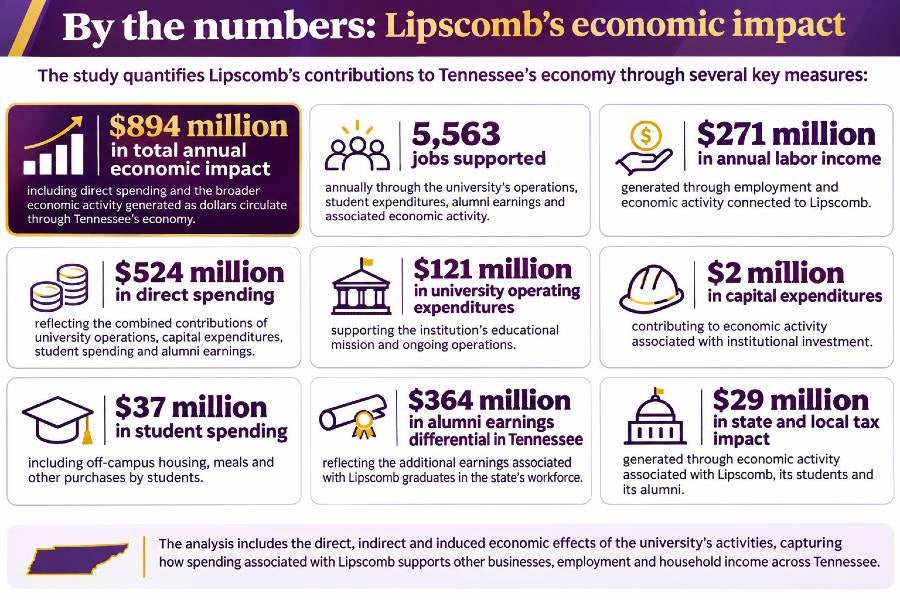
SOURCE: "The Economic Impact of TICUA Institutions: A Report for Tennessee Independent Colleges and Universities," Prepared by Regional Economic Consulting Group, August 2026.
A major employer and contributor to Tennessee’s workforce
Lipscomb’s economic contribution begins with its ongoing operations and extends through the thousands of students and graduates whose education, careers and spending help strengthen the state’s economy.
With approximately 1,560 faculty and staff, Lipscomb is an important employer in the Nashville region. The university’s operations support jobs and spending across numerous sectors, while its students contribute to the local economy through housing, food, transportation and other everyday purchases.
The university’s economic influence also continues long after students graduate. Nearly 64% of Lipscomb's 37,901 living alumni — 24,244 graduates — reside in Tennessee, contributing their talents and expertise to businesses, schools, hospitals, nonprofit organizations and communities throughout the state. The study estimates that the additional earnings associated with Lipscomb graduates working in Tennessee contribute $364 million to the state’s economy.
Innovative programs address Tennessee’s critical workforce needs
Lipscomb University’s economic impact is also reflected in its continued investment in academic programs, industry partnerships and innovative pathways designed to address workforce gaps and prepare professionals for high-demand careers.
Over the past two years, the university has launched several initiatives that expand access to education and create new talent pipelines in healthcare, education and other essential industries:
Addressing anesthesia workforce shortages. In August, Lipscomb welcomed its inaugural class to Tennessee's first Master of Science in Anesthesiology program, which prepares certified anesthesiologist assistants (CAAs). The program is also the nation’s first housed in a college of pharmacy. The launch comes at a pivotal time for Tennessee’s healthcare workforce, following the passage of state legislation that took effect Jan. 1, 2026, allowing CAAs to practice in Tennessee for the first time under the supervision of licensed anesthesiologists. Developed in collaboration with healthcare partners, Lipscomb’s program is helping to establish this new profession in Tennessee and preparing highly trained professionals to address critical shortages in the anesthesia workforce and expand access to patient care.
Expanding educator apprenticeship opportunities statewide. Lipscomb is partnering with the Tennessee Department of Labor and Workforce Development to launch the Tennessee Education Apprenticeship Collaboration Hubs (TEACH) initiative, a new statewide network designed to strengthen Tennessee's education workforce. Through regional hubs serving West, Middle, Southeast and East Tennessee, TEACH will provide school systems, early childhood providers and other education employers with the expertise, resources and partnerships needed to establish and expand high-quality apprenticeship programs. Building on Lipscomb'’ experience developing employment-based educator preparation pathways, the initiative will help employers create sustainable workforce pipelines, increase access to apprenticeship opportunities in rural and underserved communities, and address critical educator shortages across the state.
Strengthening Tennessee’s early childhood education workforce. In 2025, Lipscomb was selected as Tennessee’s first Early Childhood Education Apprenticeship Hub. Through its Foundations to Futures initiative, the university is partnering with state agencies, philanthropic organizations and early learning employers to provide aspiring educators with a debt-free pathway to a bachelor’s degree while they continue working in early childhood classrooms. The innovative earn-while-you-learn model combines paid, hands-on experience with a flexible, fully online degree program, removing financial and geographic barriers to higher education while preparing qualified professionals to meet the growing demand for early childhood educators across Tennessee.

Building Tennessee’s rural nursing workforce. Through its Tennessee Rural Workforce Initiative for Nursing, launched in 2025 with support from state grants, Lipscomb is helping expand the pipeline of nurses serving rural communities. The initiative connects students from rural Tennessee with accelerated nursing education, clinical placements and health care employer partnerships, including opportunities involving TriStar NorthCrest Medical Center. The program is designed to strengthen access to qualified healthcare professionals in communities where workforce shortages can be especially challenging.
Creating accelerated pathways into nursing careers. Lipscomb’s Accelerated Bachelor of Science in Nursing program provides a 16-month pathway for individuals who already hold a bachelor’s degree or higher in another field to transition into nursing. The hybrid program combines online instruction with hands-on clinical experiences, allowing students to enter the nursing profession more quickly and helping meet workforce demand in Nashville's $97 billion healthcare industry.
Together, these initiatives, along with numerous others, demonstrate Lipscomb’s commitment to aligning academic innovation and programming with the needs of employers and communities, developing talent pipelines that strengthen Tennessee’s workforce while expanding opportunities for students.
Independent higher education generates $22.4 billion statewide
Lipscomb’s findings are part of a broader study highlighting the economic significance of Tennessee's independent higher education sector.
According to TICUA’s report, Tennessee’s independent colleges and universities collectively generate $22.4 billion in annual economic impact, support 135,490 jobs and produce nearly $6.8 billion in annual income across the state. The report also found that the economic activity associated with these institutions generates more than $695 million in state and local tax revenue, demonstrating that private, nonprofit colleges and universities provide substantial public economic benefits while operating independently of the state's public higher education system. Together, TICUA institutions serve more than 77,000 students and award more than 23,000 degrees annually, preparing graduates for careers in some of Tennessee’s largest and most important employment sectors.
“Independent colleges and universities are deeply woven into the economic fabric of Tennessee,” said TICUA President Cameron Conn. “Every day, these institutions educate and prepare Tennesseans for the workforce, employ people in communities across the state and generate economic activity that reaches far beyond their campuses. This report puts numbers behind that impact and demonstrates that Tennessee’s independent institutions are proven partners, delivering powerful returns for students, communities and the state.”
The economic impact study is based on fiscal year 2023-24 institutional data and examines both direct economic activity and the broader effects of institutional expenditures, student spending and alumni earnings.