Lipscomb competes in national preliminaries of moot court competition
Two students on the five-year-old moot court team were selected to be Lipscomb’s first competitors at the national level in January.
By Janel Shoun-Smith | 615-966-7078 |

All Lipscomb Competitors at the Regional Moot Court Tournament (l to r): Benjamin Davidson, Austin Brewster, Kynnedy Gilbert, Rylan Cruise, Hareth Al Abdallah and Matthew Tanner.
This January Lipscomb’s Fred D. Gray Institute for Law, Justice & Society (LJS) sent its first student team to the preliminary rounds of the national tournament for the American Moot Court Association’s annual competition.
Students Ben Davidson, a junior business major from Houston, and Austin Brewster, a freshman LJS major from Memphis, competed in the national rounds (virtually due to Winter Storm Fern) after they made it to the quarter-finals at their regional tournament in November.
Lipscomb began participating in the undergraduate moot court association five years ago. At this year’s regional tournament, Lipscomb’s students competed against 32 teams, many from prestigious universities or colleges that have competed in moot court for decades, said Kimberly McCall, director of the institute.
Judges choose winners based not on who would have won the case, but based on how well students present both the pro and con arguments for a case regarding constitutional issues. The judge for the competition asks the students questions about the case, just as if they were arguing before the Supreme Court of the United States.
Lipscomb fielded three teams at the regional competition. “All the teams did well, but Ben and Austin, after the first day, were ranked No. 1 in the competition as they headed into the elimination bracket,” said McCall.
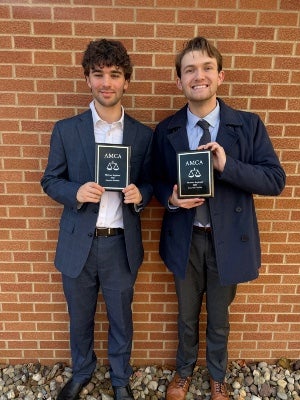
Austin Brewster and Ben Davidson
“Ben and Austin had a thorough knowledge of the case pattern. They put in hours of preparation,” said McCall, who provides students with the case problem to study in May and begins preparing the team for the competitions in August. They meet to practice every week, she said.
“Because they had such a command of the case law, they were able to be very conversational, which is key. It’s important not to come across as combative,” she said. “Part of their job is to inform the bench of how this issue has played out in the courts. They did a great job of explaining the legal landscape to the judges.”
The 2025-26 case for the competition involved gender discrimination and free speech rights, both in a higher education setting. The topic proved to be particularly relevant to real-world debate as free speech issues came into the public consciousness in the aftermath of the killing of Charlie Kirk in September 2025.
Davidson, who is in his second year competing in moot court, said “I love being able to immerse myself in messy, real world legal issues, which is exactly what this competition prepares competitors for.”
Davidson said that one of the most valuable parts of moot court is “the exposure I receive to interesting people. At this point, I’ve had the opportunity to argue in front of a senior counsel to the CIA, attorneys that exclusively practice in the Supreme Court of the United States, and partners at prominent national law firms,” he said. “Being able to speak with these sorts of people and receiving feedback on how to improve is something I value.”
Brewster said he certainly discovered his drive to compete through the experience. “I think that law can get a bad reputation as being boring, and moot court really lets you showcase how dynamic and interesting it can be,” said Brewster, who hopes to become an attorney. “I developed the ability to articulate my thoughts accurately and analyze large amounts of information critically.
“I think moot court is an excellent outlet to learn how to process, memorize and interpret information,” he said. “This will undoubtedly be essential in my future career, even if I don't intend to be a constitutional lawyer!”
Davidson is currently studying for his LSAT and preparing to apply for law school. “Moot court provides an excellent background to draw on when going into law school,” he said. “It helps establish your foundations in legal research while also translating these skills into the courtroom. If anyone is considering ways to get a leg up going into law school, I would highly recommend moot court.”
“I am training them to be advocates in life, and to be courteous and respectful,” said McCall. “I also want them to be the most prepared person in the courtroom. You can be the strongest advocate based on your preparation.”
The LJS institute also coordinates a student mock trial team that typically involves about ten students each year, said McCall. Mock trial competitions engage a larger group of students replicating the individual roles in a trial. The mock trial team will compete in its annual competition this month.