Hannah Fritsch’s Book House tells the story of how reading opened a world of wonder, possibility
Kim Chaudoin |
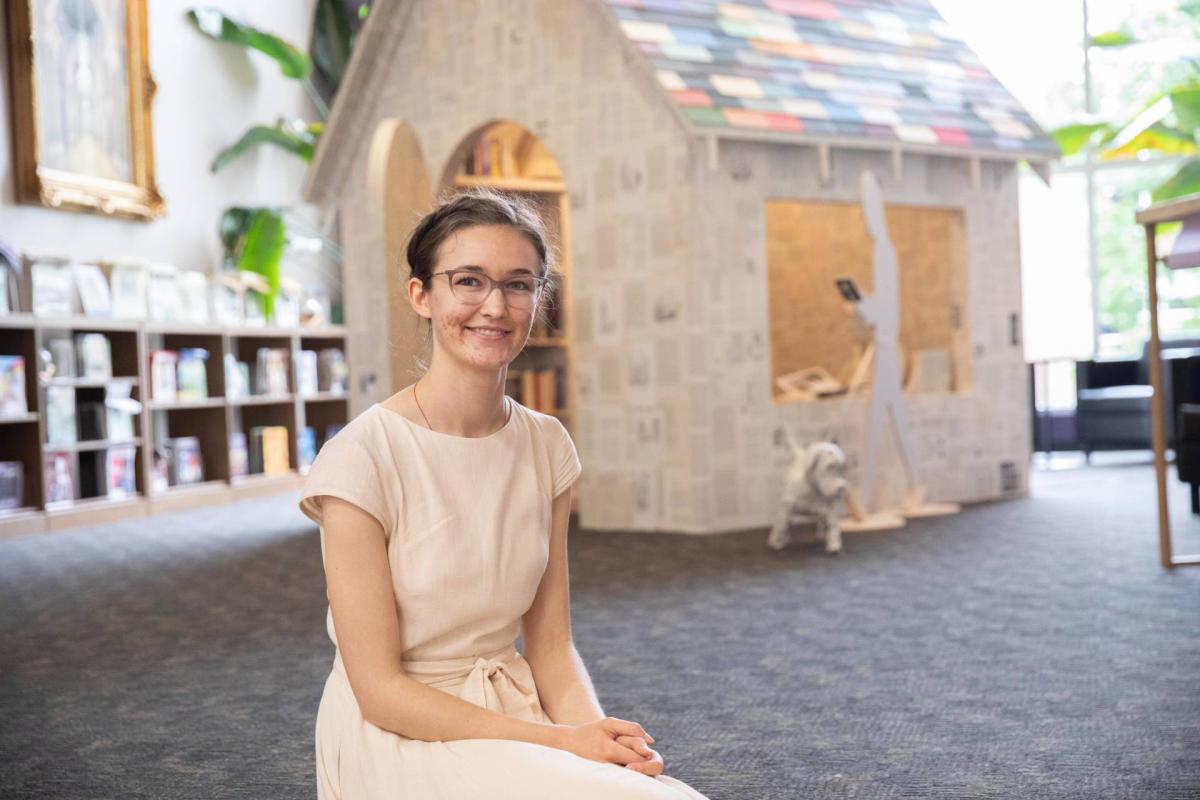
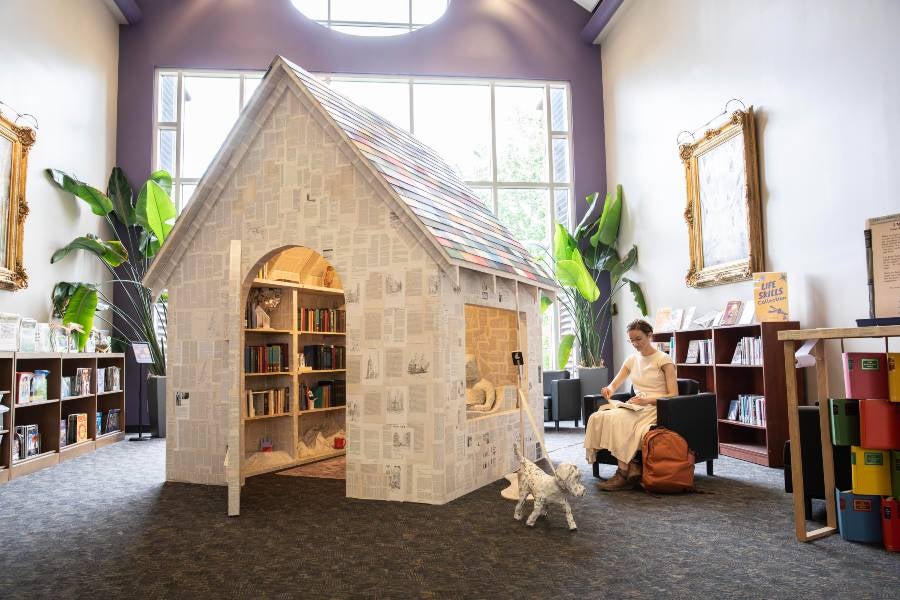
At 11 feet tall, Hannah Fritsch’s Book House is hard to miss.
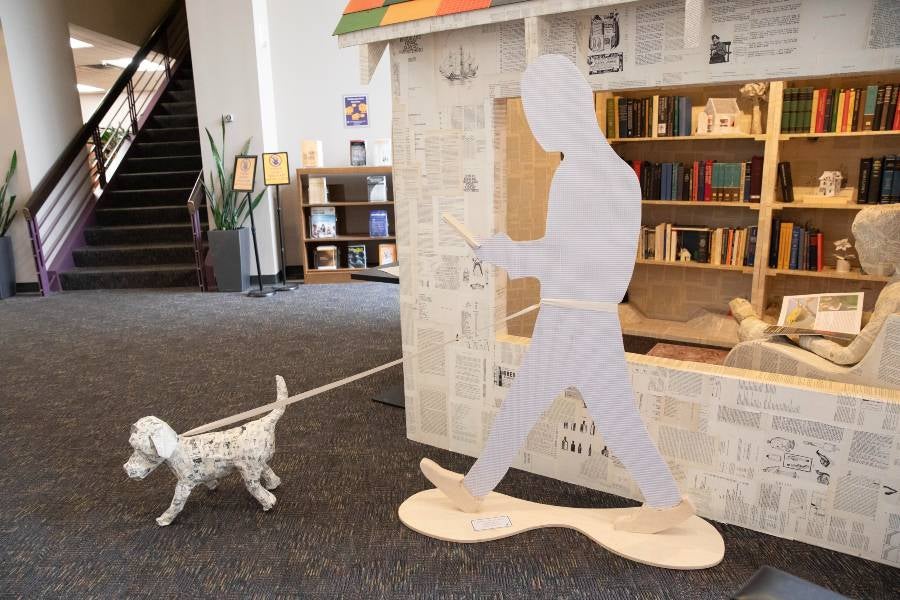
Built from wood, thousands of pages and about 900 books once destined for a landfill, the structure rises inside the atrium of Lipscomb University’s Beaman Library. Visitors can walk inside it and take in a world made almost entirely from the written word.
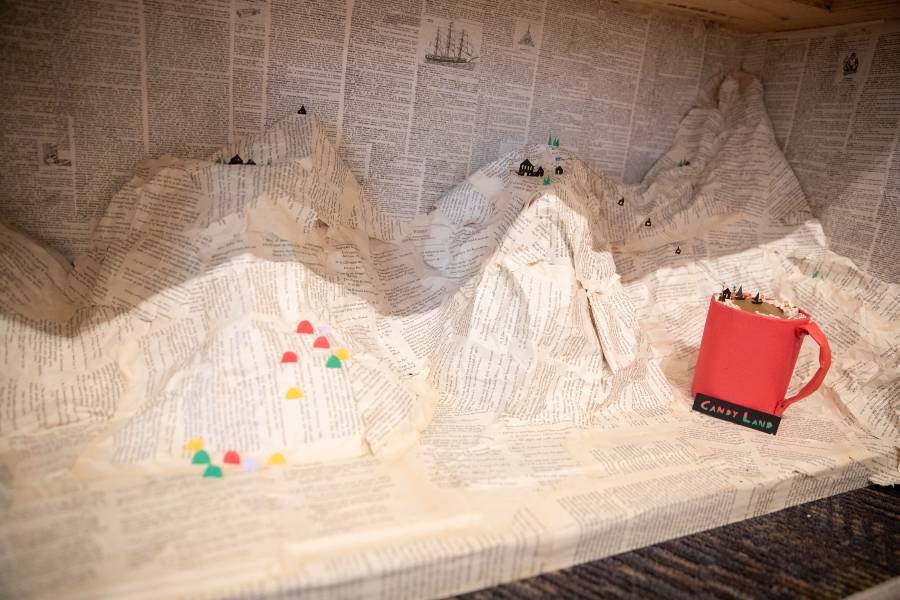
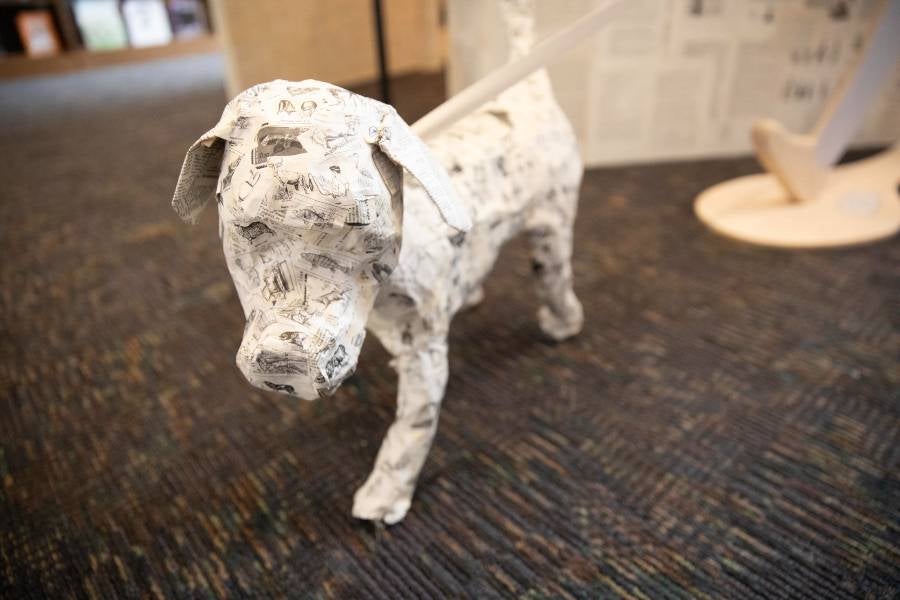
There are walls covered in pages from old books. Shelves made from repurposed packing crates. A full-size chair with a papered figure sitting and reading. Outside the house, a figure walks a dog, both covered in carefully selected book pages. Inside, there are miniature worlds tucked throughout the installation, a mouse house, a mug of hot chocolate with sailboats floating on top, mountains, a castle waiting for a dragon to be created, a ladder, an owl, a pine tree and other small surprises that invite visitors to slow down and look closer.
But for Fritsch, who graduated in May with a Bachelor of Arts degree in history, the Book House is more than a creative project.
It is a monument to the impact books have had on her life.
“I have dyslexia,” said Fritsch, of Columbia, Tennessee. “For years, books were something I could only experience through other people who read them aloud to me. But at nine years old, when I was finally able to read whole sentences and climb through the wardrobe myself, I was intoxicated by a love for books that has never left me.”
Diagnosed with dyslexia at age 6, Fritsch remembers years of daily tutoring, frustration and the painful awareness that reading came easily to others, including her younger brother, who learned to read at 3.
“I remember thinking that I'm nine years old and I still can barely sound out something with three letters,” she said.
A specialist who evaluated her once told her mother that Fritsch would likely never be able to read fluently and that if she went to college, someone would have to read textbooks to her.
With her mother's determined assistance, who tutored her daily, Fritsch began to read. By age 11, she was reading chapter books, and as her reading ability grew, she read everything she could.
“Books became my answer for everything, my ticket out of a hard day, an outlet for my incurable wanderlust and the way I learned about how little I really know,” she said. “They taught me how to wonder.”
Between the ages of 12 and 18, she estimates she read 2,000 to 3,000 books.
“Being able to read, that was the greatest accomplishment I’d ever had. The Book House represents the thousands of books that I have read. This is a way of showing that just because somebody says you can’t … I mean, look,” said Fritsch as she gestured toward her creation.
Fritsch said the idea for the Book House began during a drive home from church with her brother. They were discussing the difference between digital media and physical books, about how quickly people can search for something online and feel like an expert, and how different that experience is from the slower, deeper work of reading.
“Google gives instant results and makes you feel like an expert,” Fritsch said in her project description. “But when you pick up a book, you get something different. You read 100 pages, you feel the paper and the whole experience takes time. You have the opportunity to gain a deeper kind of knowledge.”
That conversation sparked a question in Fritsch’s mind, "What would it look like to show the difference between someone who simply consumes information and someone who actively imagines, reads and creates?"
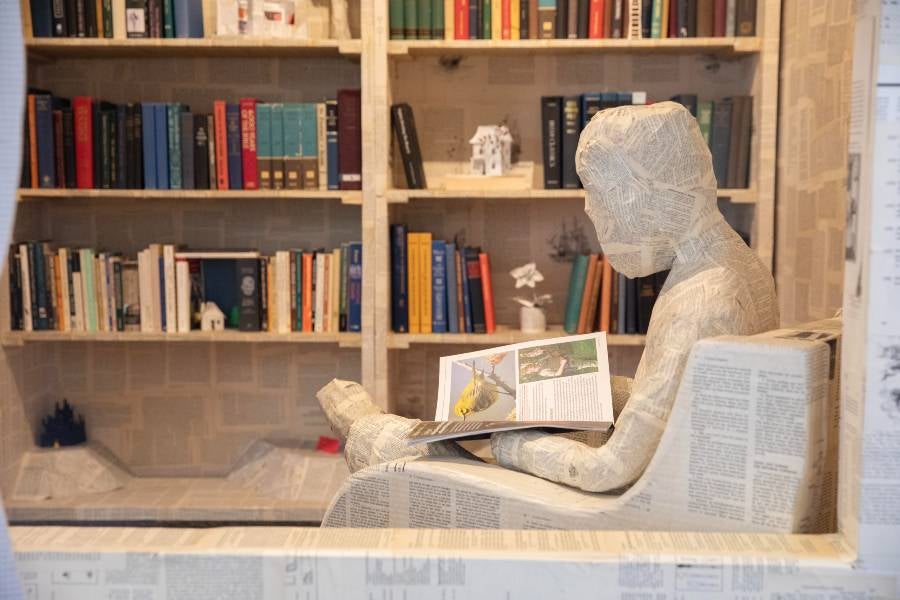
Her first idea was a paper person sitting in a chair, reading. Then Fritsch realized the person needed a setting. If she did not have a library in which to place the figure, she decided, she would build one.
“I thought, ‘Well, I don’t have a library to set this in, so I should build a library,’” admitted Fritsch.
The project grew from there.
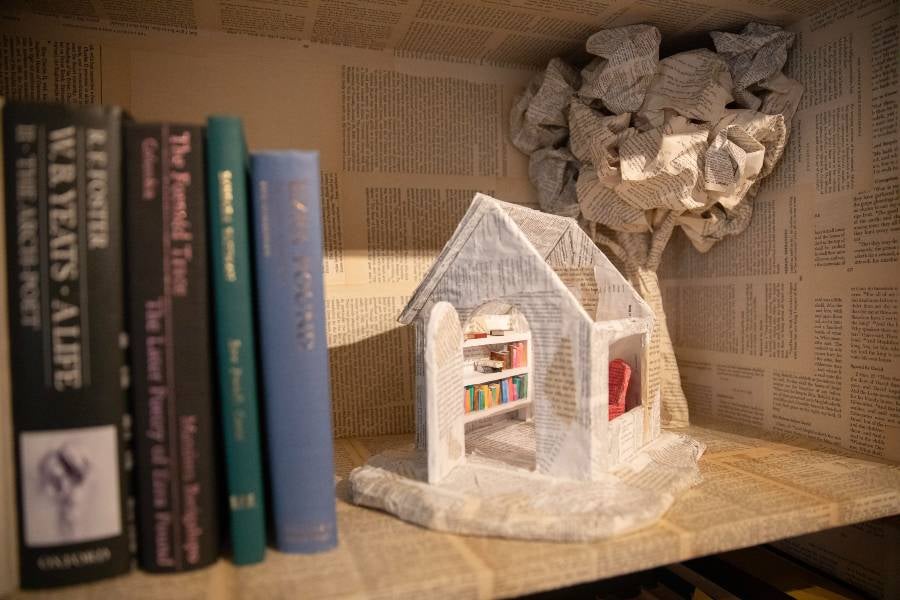
She built a scale model and initially pitched the idea to the Nashville Public Library. She knew the concept sounded ambitious, especially for a 22-year-old student. Still, she was not deterred.
“I kept going, and this is the result, my version of imagination,” she said.
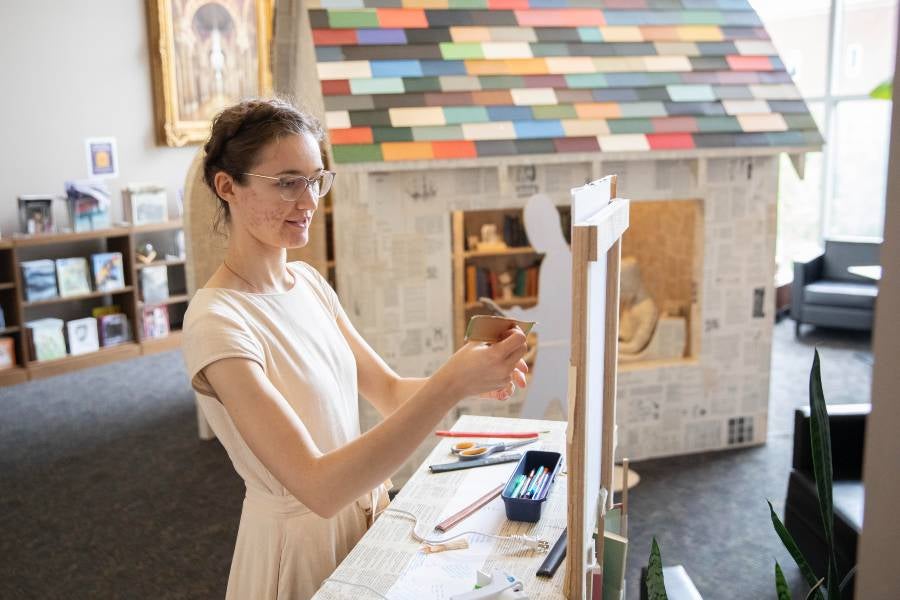
Fritsch began building the wooden frame last summer with help from her father, a general contractor. The frame was designed in panels for easy transport and assembly. Her father brought the structure to campus in his van, and the two spent about three hours putting it together before Fritsch finished the edges and final details.
The books came through a chance connection in her hometown. After canvassing shops in Columbia in search of books for the project, Fritsch spoke with the owner of Duck River Books, who had recently decommissioned a college library in Virginia and had thousands of books that otherwise would be discarded. He offered her about 1,500 books.
Many of them became part of the Book House.
Colorful book covers adorn the roof as shingles. The outside is papered in pages from old collector manuals and quotation books. Inside, the walls are lined with pages from dictionaries, books on household maintenance, literature and history among other topics. Fritsch selected pages intentionally, often matching the source material to the object it covered. The chair is covered in pages from a book about reupholstering and refurbishing furniture. The dog is covered largely in images from sports, gardening, animal and bird books.
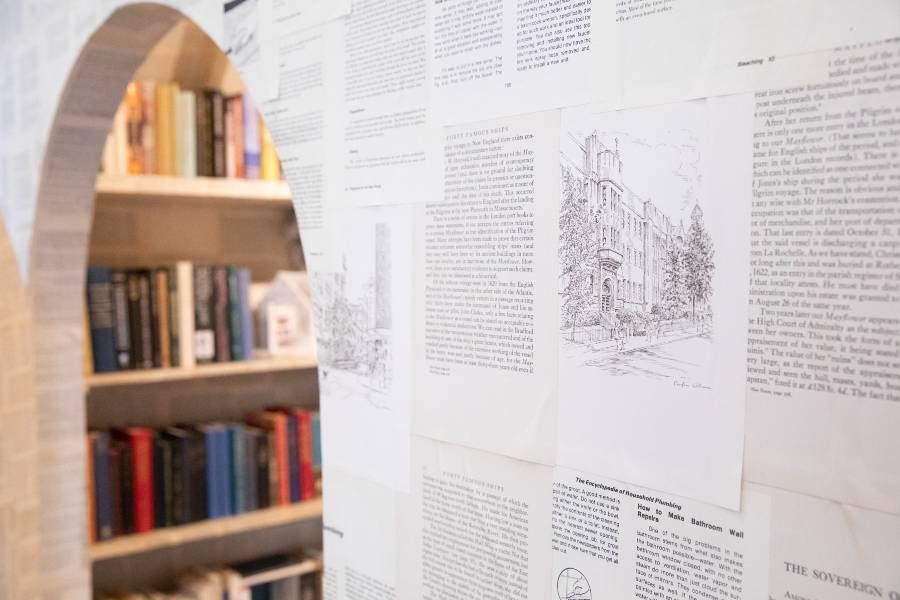
“Everything is layered in paper, creating a world built entirely from the written word,” said Fritsch.
The details inside the Book House are personal, whimsical and tied to Fritsch’s imagination. The hot chocolate scene, for example, came from a childhood idea of what would make a perfect world.
“That was my idea of what would be amazing and a good time when I was little,” she said. “If I could make any kind of world, I would have a swimming pool of hot chocolate.”
The mountains reflect another lifelong fascination.
“I’ve always, always loved the mountains and just the idea of skiing or climbing mountains,” she said.
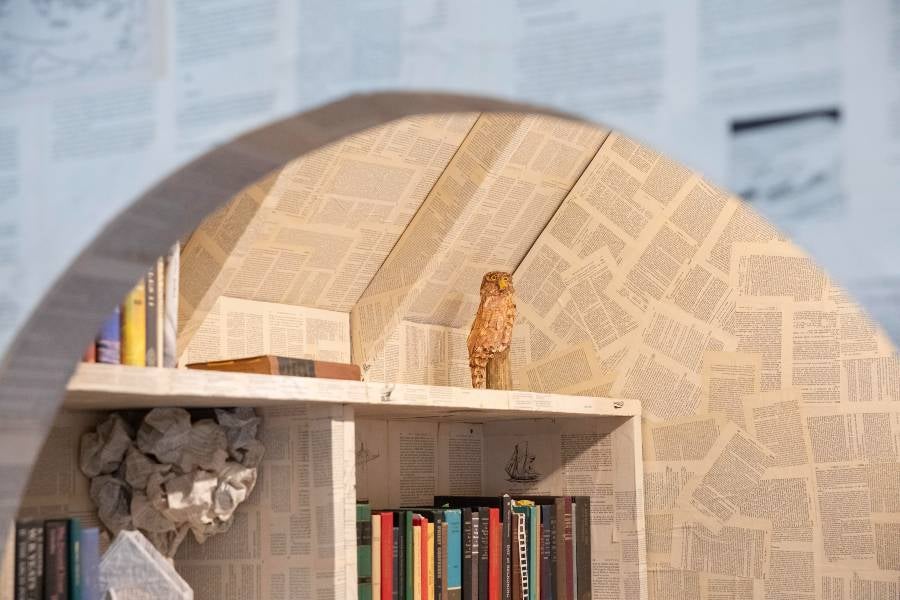
The owl and pine tree are among the oldest of her paper creations, made before the Book House itself. Many of the miniature pieces were created simply because Fritsch enjoys making things from book pages.
“This is my version of relaxing,” she said. “It makes me happy.”
That joy became the centerpiece of her project for Lipscomb’s 2026 Student Scholars Symposium, which took place April 15-16. The Book House project, titled “Imaginate: Other Worlds | What We Make of Books,” was completed just before the symposium and is now on display in Beaman Library. It will be on display through the middle of May.
When she and her father assembled it on campus, Fritsch said she was struck by its size.
“It was bigger than I remembered,” she said. “I thought, ‘Oh, wow, OK, yeah, now I see why people are saying that’s crazy.’ But it’s really exciting to me.”
Fritsch hopes the project will continue to grow, perhaps with new elements added as it moves to other locations. She hopes it may eventually be displayed in a library in the region.
For now, she hopes those who encounter it in Beaman Library will pause.
“What I hope people take away from this is that they actually take a moment to pause,” said Fritsch. “That’s the main thing.”
“You cannot simply sit back and let the visuals wash over you as with a video,” she continued. “You interact with the work, your mind is engaged and you contribute to the story. You become a part of it, and it becomes art.”
Fritsch’s own academic journey has been shaped by the stories she first encountered in audiobooks and later in her own reading. She began her college career at Columbia State Community College where she earned an associate degree before transferring to Lipscomb, where she completed her bachelor’s degree in history in two years and nine months by taking classes year-round.
“When I finally went to college, I realized that all of that reading was about to pay off in a major way,” she said. “I had a foundation in almost every topic I studied, and instead of getting bogged down in the material, I was able to go down rabbit holes and explore deeper questions while many of my classmates stayed tied to the textbooks. That’s what books do. They open new doors.”
After graduation, Fritsch plans to begin work on a master’s degree in conflict management at Lipscomb.
— Photos by Kristi Jones