Faculty mentors, volunteering and the CVD all steered Lexi Price to her dream job
Service was major factor in Price discovering her calling and landing a job at Nashville's Warner Parks.
By Andrea Zahler |
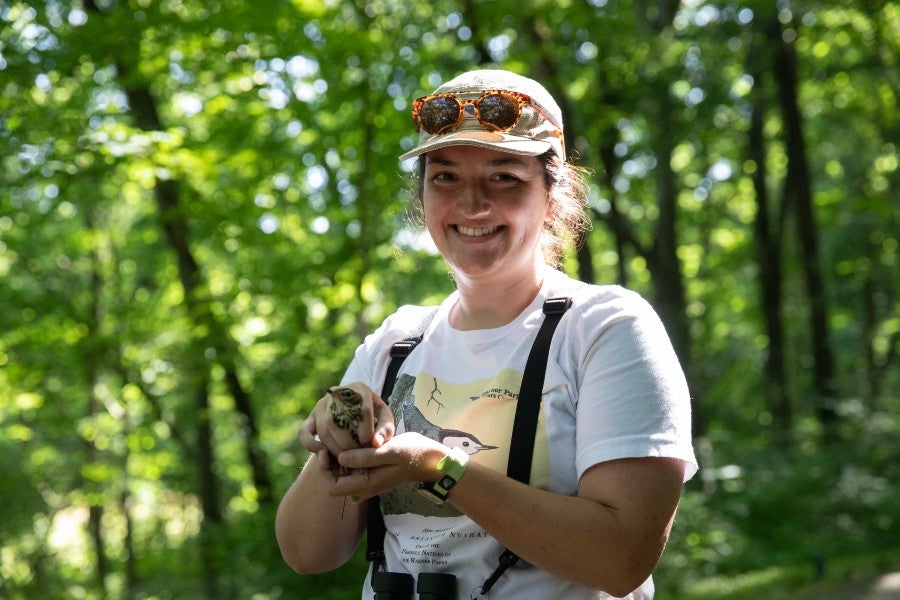
Lexi Price (BS ’26) is living the dream.
“Looking back, I know that what I have now was always my dream job. It just didn’t exist yet,” says Price, community conservation educator at Nashville’s Warner Parks—one of the largest municipally administered parks in Tennessee.
In her role, Price leads afterschool programming and creates and maintains pollinator gardens at community centers around Nashville as part of Warner Parks’ Nature Discovery Program.
“It’s right there at the intersection between science and education. When I saw the job listing, I just knew that it was mine,” she says.
The journey to her dream job, however, was not always as clear. It took a combination of four years of personal mentorship, volunteering, service learning and growth at Lipscomb for her to identify her calling and nab the perfect job right here in Nashville.
Price loved biology and entered Lipscomb as a pre-med major. “I had Dr. Matt Hearn as a mentor and he emphasized the importance of networking as soon as possible.” Being new to Nashville, Price did not know anyone in the city yet, so she decided to network by taking advantage of all the resources available to her on campus.
She reached out to John Lewis in the biology department who invited her to participate in a collaborative research project on birds at Warner Parks.

“The winter of my freshman year I started coming out to the parks and very slowly dipping my toes into some of the programs we have here,” she says. “I started to feel like pre-med didn’t fit me well. I knew I loved biology, and I knew I loved the environment. I think I was actually one of the first people to go to Rob Touchstone in the Center for Vocational Discovery (CVD).”
Lipscomb’s CVD helps students explore opportunities at the intersection of their academic aspirations and life purpose. “We had a really great conversation,” says Price. “Eventually Rob said, ‘you know the first time I’ve seen you smile since you came in here was when you talked about the environment.’ That day I left the CVD and changed my major to environmental and sustainability science.”
Volunteering while a student also equipped Price for her dream job. The university re-structured how it teaches environmental science in Price’s sophomore year prompting her to look for new ways to connect to her passions. “It was hard, but also great because I got to take cool classes I wouldn’t have been able to otherwise and volunteer through Hands On Nashville,” she recalls.
In addition to consistently volunteering at Warner Parks as a student, Price led bingo games at FiftyForward, a local nonprofit supporting older adults. “Sometimes seniors don’t get a lot of attention,” she says, “but they’ve lived a whole life and have so much to say—so many thoughts, opinions, wisdoms and insights. They just want someone to hear them! I got to do that.”
Price also volunteered as an afterschool tutor with nonprofit Dream Streets. “I thought I would be a tutor, but I ended up being more of a buddy. I realized that what kids want more than anything is for someone to talk to them like they are the most important thing in the whole world. I got a lot of practice giving my full attention to those kids,” says Price.
She gets plenty of opportunities to use those listening and communication skills she developed through volunteering in her work today with students enrolled in the Nature Discovery Program. “Even if the kids are talking to me about something that has nothing to do with my lesson, if they are excited about it, then I want to hear about it. I think that’s what Jesus did and that’s what we can do here,” she said.
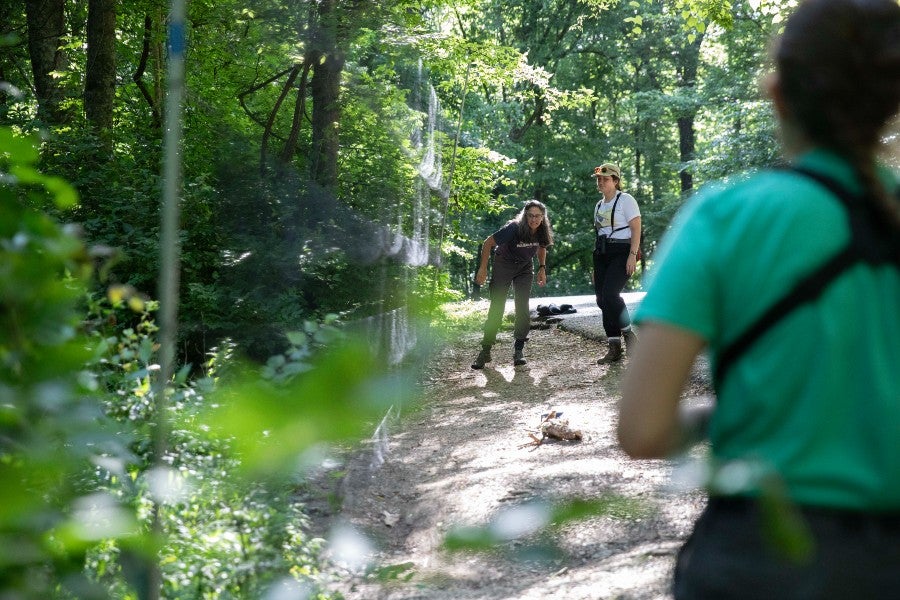
In spring 2024, Lexi Price worked with Warner staff and other interns to catch wood thrushes in a net and band them for a grant-funded research project at the park.
Of course, most of the time the kids’ excitement comes directly from her lessons. Within the program is the Nature Detectives Club, which meets after school in 18 community centers once a month.
“Our team has a rigorous curriculum structure we fill out with a different lesson each month,” she says. “[September’s lesson is] called ‘Back to Basics.’ How do you make observations like a naturalist? We give them hand lenses and let them make observations. It’s amazing how quickly you can get a group of 4th- and 5th-graders to stare at a tree for a long time because they realize it’s actually really interesting. We let them run around and explore.
“We also make sure whatever approach we use for our lessons is accessible so every kid feels included and can share in what we do. It’s important that every kid feels seen. I like to emphasize kindness to each other, kindness to nature and kindness to themselves. It’s such a joy!”
Each child in the club gets a journal to keep track of their observations. “Just two days ago,” adds Price, “a nine-year-old girl showed me her journal and the drawings she did were incredible! She wanted to identify ants and asked for a whole field guide just on ants.” When Price returned to her office, she ordered her one. “I want her to have that guide!”
The Nature Discovery Program itself has been fundamentally shaped and driven by the community centers, said Price. “They’ve spent so much time building their communities, so they know their strengths and histories, and they already have great programs,” she said of the centers. “We offer to add in nature exploration. We try to create things that we and the community center leaders are passionate about, then we just follow whatever excites people, and that has turned into a very flourishing program.”
Price points to the community gardens as an example. “What we wanted was to plant pollinator gardens at community centers to bring native plants back to Tennessee. That’s all we really had in mind. We work with the centers to pick sites, and the kids are the ones who plant the plants,” she said. “People love flowers and walking through those gardens. Now at one of the centers there are a lot of seniors who are interested in exploring more, so we are going to create a program for them.
“I was at Kirkpatrick Community Center when we planted their garden and a sweet little boy came up to me holding a plant in his hands,” Price recalls. “He looked up at me and said, ‘this is the best day of my whole life! I love this! I want to go home and start my own garden!’
“And of course, I cried,” laughs Price. “It really solidified why I’m doing what I’m doing, and it solidified why God made me. It’s really cool to see the growth of these kids and the growth of their passion and self-confidence.”
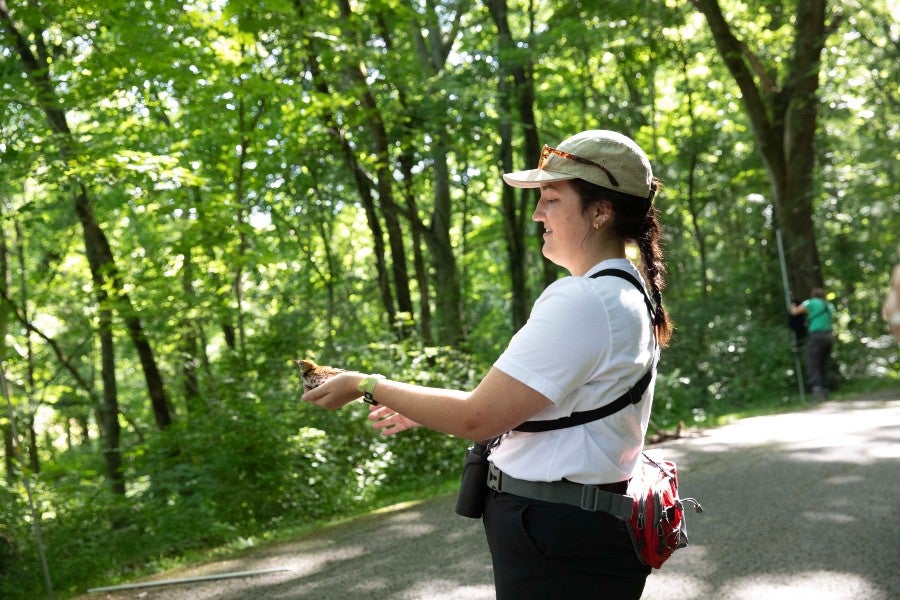
Price says it is easy to get excited about nature because it reminds people that there is something bigger than themselves. “When I’m in a garden, sometimes I get overwhelmed with the amount of work there is to do, but then maybe I’ll see bees that haven’t been around in a while or a special kind of bee that only pollinates this one particular plant,” she reflects. “I’m reminded that God is so good and creative and that I get to be a tool and get joy out of what I do because… I’m also serving a bigger purpose.”
For Price and Warner Parks, nature is not a place to escape from people—it is a way to connect with people, she said. “At the core of everything we do is relationships: relationships with each other, with our communities and with the Nashville community as a whole. We try to build relationships with everyone because to effectively conserve the environment we have to protect human interests first. Make sure humans are taken care of and feel loved before we can move toward environmental protection,” she said.
“[Lexi Price] is one of the brightest, most self-motivated students I've had the pleasure of teaching,” said Lewis. “She explored several different post-graduate paths, and I think she's landed right where she wants to be and is making an impact in her community—our community—through her work at the Warner Parks.”
Price joined fellow alum Anna Sawyer (BS ’24), at Warner. Lipscomb now has four alums working at Metro Parks Nature Centers, the other two being Zach Knight (BS ’23) at Beaman Park Nature Center and Perri Haga (BS ’22) at Shelby Bottoms Nature Center.
For Lipscomb students who are still trying to find their passion and purpose, Price has one piece of advice: “It’s a cliche, but I always say to volunteer. Go do whatever sounds interesting to you. The great thing about volunteering is that it’s very low stakes. If you don’t like it you can move on to find something you really do get joy from. At the end of the day, your job is just one part of your whole self. It’s great to get as close as you can professionally to what you really want, but volunteering can be a good way to find fulfillment and do some self discovery.
“I mean,” she adds, “I would not have this job if I hadn’t volunteered.”