Coding the future in AI
More than three years into the AI revolution, Lipscomb is ahead of the pack in researching, teaching with and educating about artificial intelligence.
By Janel Shoun-Smith | 615-966-7078 |

Jump to See Specific AI Projects
November 30, 2022, is certainly a day that will go down in history.
That’s the day that OpenAI released ChatGPT to the public, and within two months the platform had 100 million users. It’s not a stretch to predict that in future historical texts, our world may be categorized as “before AI" and “after AI.”
Artificial intelligence (AI) is already changing the way we live, work and learn. Students entering college today are already graduating into a world where AI is integrated into nearly every profession
At Lipscomb, that’s not a problem. We believe it’s time for education to lead, not lag, in preparing students to thrive in this new reality.
So it’s no surprise that this past school year saw classrooms filled with faculty using AI platforms to boost student engagement and understanding as well as faculty and students conducting their own research on how to use AI to educate even better.
Faculty shared AI knowledge in specific industries both informally in hallways and formally in coordinated speaking opportunities. New computing equipment keeps data analyst students on the cutting edge, and a new applied AI degree launched its first graduates into the marketplace.
From almost the beginning of this societal sea change, Lipscomb has embraced its responsibility to both help students understand the innovative tools shaping our world and instill in them the wisdom to use these tools ethically and to lead with skill and conviction.
Getting excited about AI and building out their own bots. It was the coolest thing to watch them just leap through the AI literacy pyramid. I, for one, definitely appreciate Lipscomb’s approach. — Amy Baltimore (EdD ’25)
More than two years ago, the university formed an AI Committee to develop a responsible integration strategy and appointed an AI Faculty Fellow. That group now serves as an advisory body guiding policy development, training initiatives and academic integration.
In 2024, a group of on-campus “super users” piloted use of AI tools on campus, and the university’s first AI academic program—the Master of Science in Applied Artificial Intelligence in the Raymond B. Jones College of Engineering—launched its first cohort that fall.
In summer 2025 the university released its official AI usage policy to faculty, staff and students, and gave every student, faculty and staff member access to enterprise-level AI tools through a partnership with BoodleBox, a web platform providing secure, unlimited access to top AI tools like ChatGPT, Claude, Gemini and Perplexity.
The year 2026 is shaping up to be no different with the first cohort of the AI master’s degree graduating in May, the College of Health and Human Sciences holding its own speaker series for faculty on how AI is used in healthcare and a 12-hour undergraduate certificate in applied AI to be offered as of this fall to any interested students in any discipline.
The undergraduate certificate includes four courses: Introduction to Applied AI, Modern Tools in Artificial Intelligence, Ethics and Responsible Use of AI, and AI Studio, where students will use AI platforms as a solution strategy to solve society’s problems.
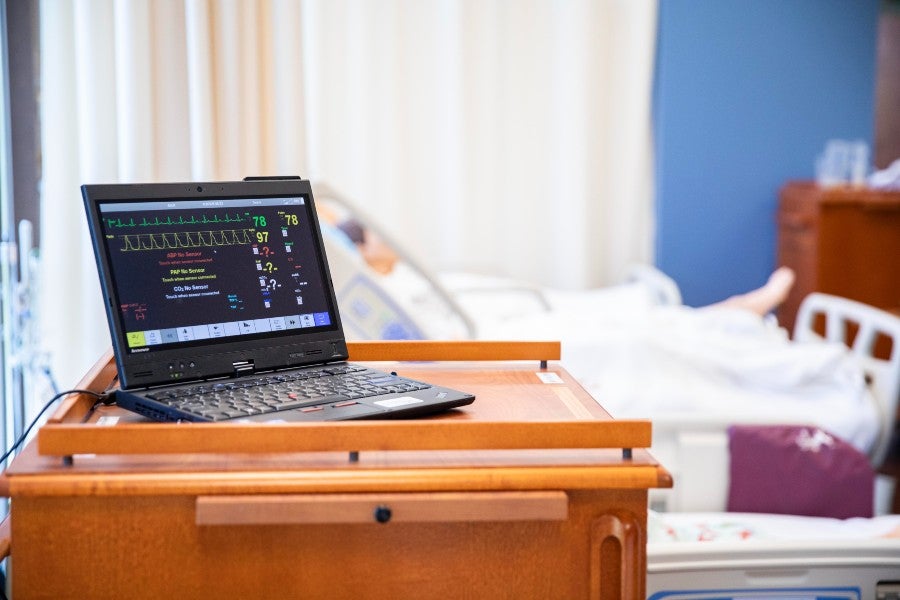
Academic innovation
On the academic side, faculty’s understanding and engagement is critical to helping students not just thrive in an AI world but to help shape it. Therefore, Lipscomb’s Center for Teaching and Learning (CTL), which works to promote and sustain excellence in teaching, has been nurturing various faculty projects in regards to AI for at least two years.
Various faculty endeavors to use or research AI for teaching have sparked from the CTL’s AI Community of Practice, a time of collaborative brainstorming and cross-germination of ideas led by Lipscomb’s 2025-26 AI Faculty Fellow Sarah Gibson; and its Scholarship of Teaching and Learning training series, a five-session series intended to help faculty create a laboratory of effective teaching within their daily classes.
These projects have included an AI study coach that uses the Socratic method to challenge students beyond surface-level description, an AI bot to guide students through the critical analysis of primary research papers, an AI navigator to discuss ethical dilemmas in case studies and a bot designed to help students collaborate and critique each other in the classroom.
The CTL began informational, baseline programming for faculty on AI two years ago and has already moved on to including the use of AI as a given throughout its effective pedagogy programming in the 2025-26 year, said Dr. Adam Wilson, director of the CTL.
Lipscomb’s placement on the cutting edge of infusing AI into higher education has become clear to Wilson this past year as he served as one of Lipscomb’s participants in the American Association of Colleges and Universities’ (AACU) 2026 Institute on AI, Pedagogy and the Curriculum, a seven-month, team-based program that helps institutions respond to the opportunities and challenges of AI.
“We are required to submit a project for the program, and since we have so many faculty already implementing AI in their classrooms, our project is actually looking 10 years into the future. In 10 years, when we have AI-native students, what are the human skills that we—as an institution and in society at large—want to make sure we protect?” said Wilson.
While a lot of institutions are reactively trying to figure out how to teach AI literacy to their students, we're proactively asking: How will AI pressure our students to change, and how can we instill in them the value of humanity within this new paradigm? — Adam Wilson, director, Center for Teaching and Learning
“Those are the kinds of things I find really forward-thinking about what we're doing at Lipscomb. While a lot of institutions are reactively trying to figure out how to teach AI literacy to their students, we're proactively asking: How will AI pressure our students to change, and how can we instill in them the value of humanity within this new paradigm?,” he said.
Based on surveys of the faculty, Lipscomb’s AI Institute cohort is determining the six key, critical skills and plans to highlight them at the fall 2026 all-faculty meeting to kick off the school year, said Wilson.
A project carried out by three Doctor of Education students in 2024-25 came up with much the same conclusions. Dr. Kendra Bush (EdD ’25), Justin Uppinghouse (EdD ’25) and Amy Baltimore (EdD ’25) conducted surveys and qualitative interviews of students and faculty at a small northern private university, and found high levels of anxiety, lack of communication and inconsistent classroom policies around using AI on campus.
Those results were far from what the students said they experienced at Lipscomb throughout the course of their two-and-half-year doctoral program. “It didn't start that way,” said Uppinghouse. “But even while we were doing this AI research on another school, it was really refreshing to see our professors in the doctorate program growing in that way.”
“Not just growing, but getting excited about it and building out their own bots,” said Baltimore. “It was the coolest thing to watch them just leap through the AI literacy pyramid. I, for one, definitely appreciate Lipscomb’s approach.”
Coding the next generation of AI managers
Lipscomb is also taking a different approach when it comes to preparing students to enter the field of AI. Instead of starting with training typical of those majoring in computer science, Lipscomb’s School of Computing began with a master’s program designed to allow any professional from any career field to learn how to become an AI guru within their profession, no matter the industry.
The first four cohorts since the Master of Science in applied AI was established include students working in robotics, information technology, marketing, education and higher education, art, social work, business, software design, engineering and graphic design.
Many of the eight members of the May 2026 graduating cohort were elevated or took on new roles in their company based on their new AI expertise, said Dr. Steve Nordstrom, associate dean of the School of Computing.
The May 2026 graduates, for their capstone projects, created exciting AI-driven programs such as an assistant for physical therapists that analyzes the patient’s movement and poses through a video feed as well as a bot to give an oral exam in chemistry classes, conversing with students through the Socratic method to boost critical thinking and ethical reasoning.
Projects in other cohorts include using AI to create an automatic sports voice-over (called AI Michaels, after famed sports announcer Al Michaels) for sporting events and a framework to help administrators of national points of interest to build AI tour guides.
This coming fall, the applied AI program will have a new director, Gilberto Diaz (BS ’17, MS ’19), who has spent many years in industry using the technology and software development skills he initially built while he was a student here at Lipscomb. In addition, a new Bachelor of Science in artificial intelligence, now addressing the need for a new wave of computer scientists to build more advanced AI for the future, has been approved for students in the 2026-27 academic year, said Nordstrom.
Keep reading to learn more about specific student and faculty projects to research and use AI in teaching today:
- AI navigator for ethical dilemmas in educational leadership
- Improving email communication in a computing course
- Bots that converse as Bible characters
- Testing AI's consistency in grading
- Personalized study coach in psychology
- Developing better tests through AI in kinesiology
- Sharing AI expertise in the healthcare industry
- Creating an AI oral examiner in chemistry
Award-winning Innovation
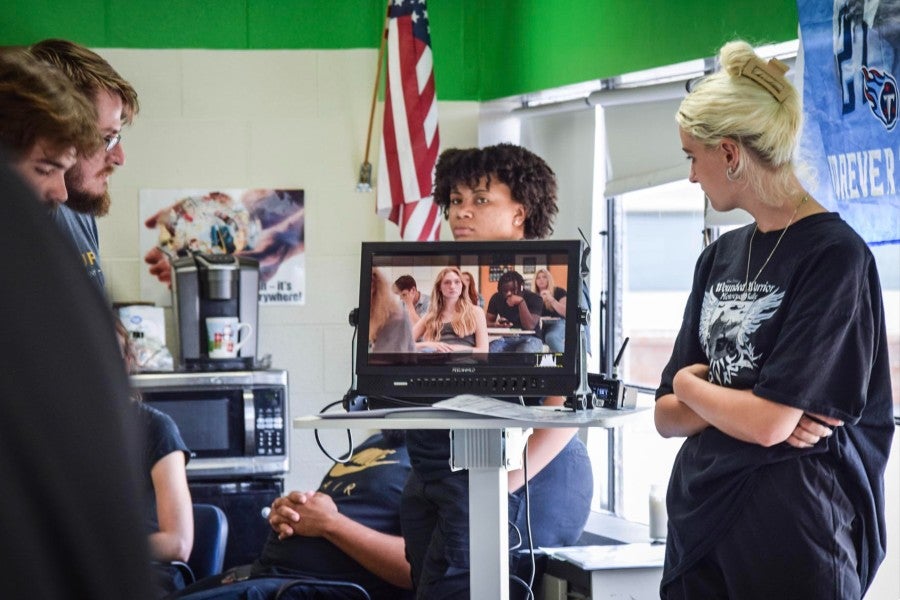
In College of Education Assistant Dean Dr. Lance Forman’s educational leadership graduate courses, students watch a Lipscomb-produced film (pictured above) depicting an ethical dilemma in schools, read supplementary documents related to the case and converse directly with the film characters by using AI-powered bots. Incorporating these bots and other AI platforms into the online courses has produced such positive results—rapidly growing enrollment, greater student satisfaction, deeper learning and a national AACTE Best Practice Award for the Innovative Use of Technology—that the College of Education is including similar usage of AI in four other online asynchronous academic programs this fall.
Learn More about Forman's Award-winning Innovation
Pumping up Soft Skills
This past spring undergraduate students in Associate Professor Dr. Dwayne Towell’s computer science special topics course on AI developed a program to help enhance email communication soft skills. The program, named Edna Modal, inspired by fictional fashion designer to the super heroes Edna Mode in The Incredibles, responds to initial emails with humorously sassy but valuable critiques to help the sender edit and improve their message before it goes to the final recipient.
Making it Personal
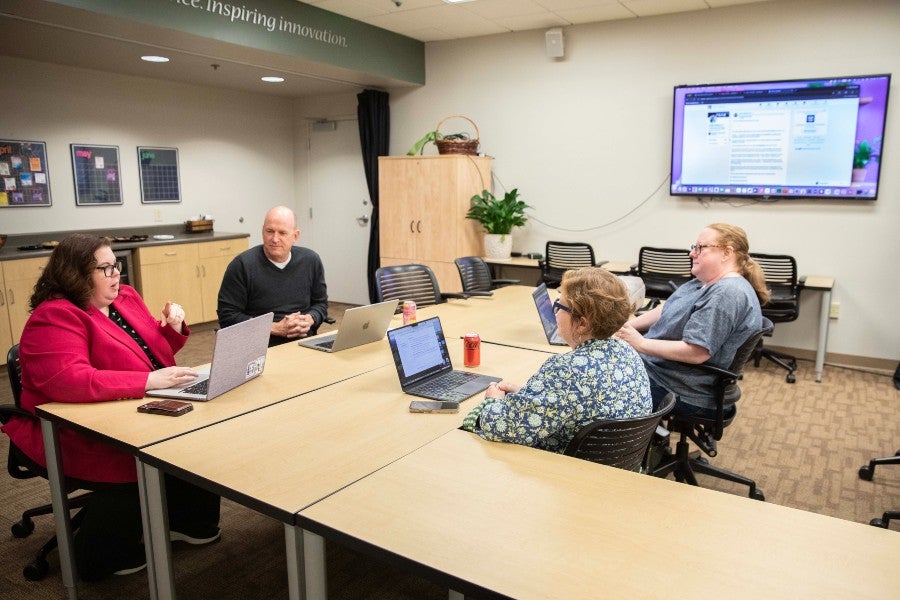
Faculty such as Meagan Spencer and Windy Frank learned innovative ways to use AI in teaching at Lipscomb's AI Community of Practice group, coordinated by the Center for Teaching and Learning.
In Adjunct Instructor Windy Frank’s Bible course, Story of Israel, students are able to spend time personally talking with AI versions of the Old Testament Bible characters they could previously only see on the page. The conversational bots created by the students help them understand the real-world emotions of the characters and the high stakes of the situations we can only read about today, said Frank (on far right in photo), who got the idea at the Center for Teaching and Learning’s AI Community of Practice gatherings (pictured above). The students had to both gather the research about their character and then know that research well enough to test the bot to see if it was answering questions as the Bible character would.
Verifying AI Consistency
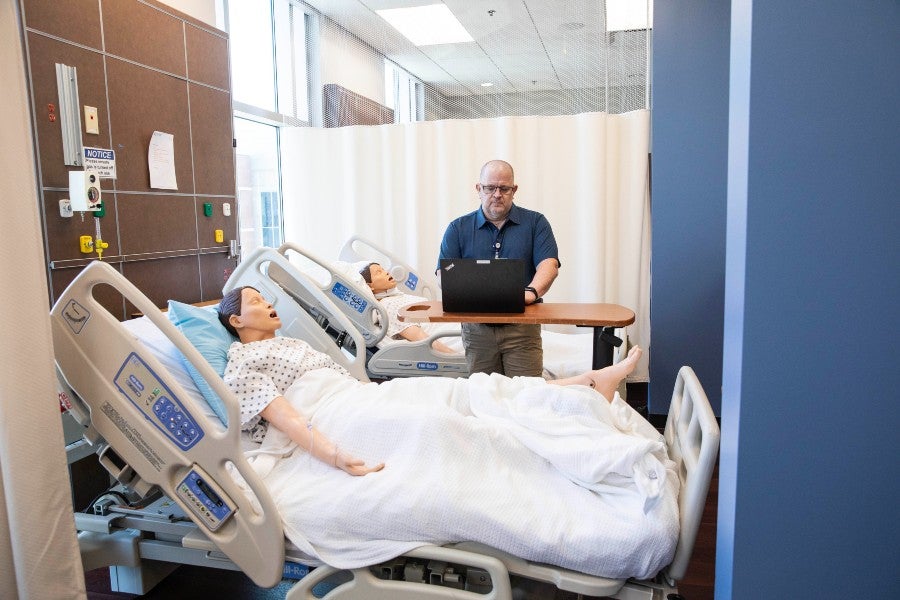
Jeffrey Adams, director of the Health Sciences Simulation Lab, enacted a research project this spring focused on verifying if AI platforms provide consistent results when used to grade health sciences students’ work in documenting patient care.
Dr. Jeffrey Adams (pictured above), director of Lipscomb’s Health Sciences Simulation Lab (who literally wrote the book on AI in health simulation: Engaging Minds: Rethinking Student Assignments in the Age of AI), also enacted a research project this spring semester focused on verifying if AI platforms provide consistent results when used to grade health sciences students’ work in documenting patient care. The investigators are testing to see if AI can take the notes from students working through a health care simulation provided by different faculty and grade them all the same way, providing a faster and consistent grading method.
Personalized Study Coach
Seniors in the Cognitive Psychology course use Coach Hildy 3.0, an advanced AI study coach that uses a Socratic coaching approach to help students evaluate the significance of research findings, identify patterns across multiple studies and connect individual findings to broader theoretical frameworks. Coach Hildy, named after Hildegard von Bingen, a 12th-century visionary, and coded by Dr. Shanna Ray, executive associate dean of the College of Liberal Arts & Sciences, challenges students beyond surface-level description toward sophisticated scholarly analysis.
Testing the AI Teacher
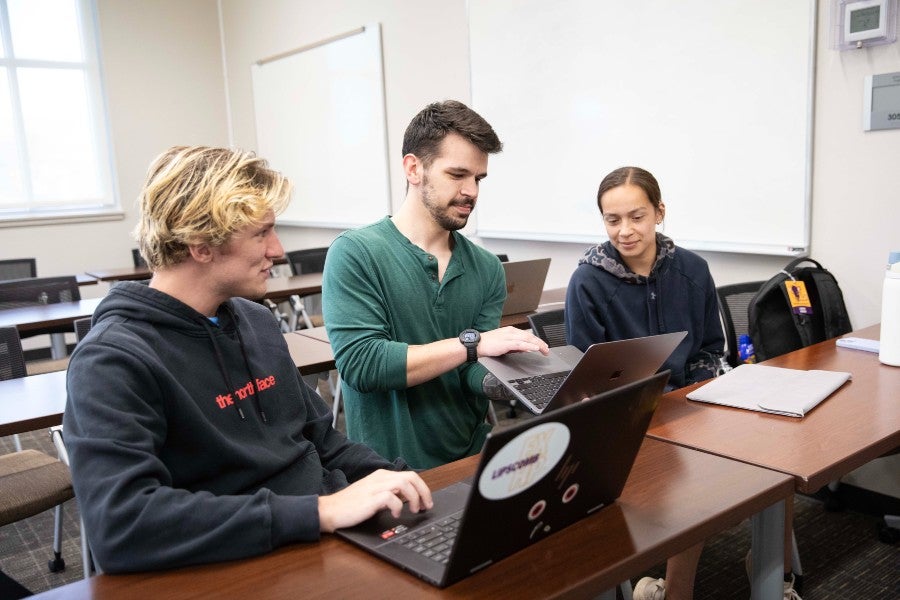
Students in Zach Droll's course have coded an AI platform to provide assessments using a teaching principle called varied repetition.
Kinesiology Assistant Professor Dr. Zach Droll (pictured above, center) is guiding his strength and conditioning students through coding an AI platform to provide tests using a teaching principle called varied repetition. Using this principle, the AI system randomly presents test questions from curriculum units covered earlier in the semester, creating spaced and randomized retrieval across the semester. Students track their usage of the system, and that data is anonymously compared with course performance. Each student serves as their own control by completing the first half of the semester without the AI system, allowing the students to evaluate whether AI-supported spaced retrieval improves learning outcomes.
Future Horizons in Healthcare
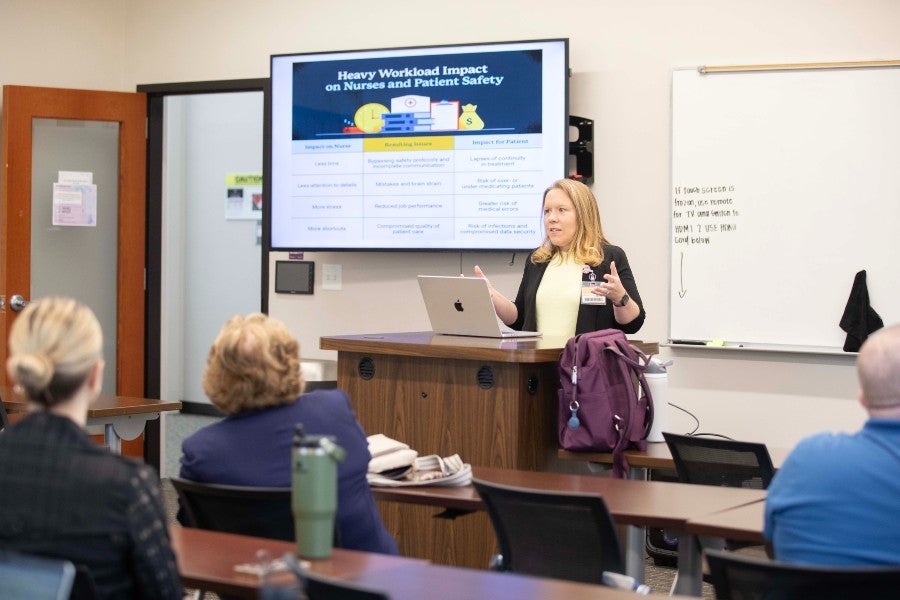
AI can be used to aggregate data from patient charts into comprehensive summaries, reducing the time nurses spend on documentation and data review, says Jenna Sissom.
The health science faculty who developed the Applied Artificial Intelligence in Health Care course for Lipscomb’s applied AI master’s degree, gathered to share their expertise with faculty this past school year in the Healthcare Horizons Speaker Series. Jenna Sissom (LA ’03) (pictured above), assistant professor in the School of Nursing, discussed how AI can be used to aggregate and synthesize data from patient charts into comprehensive summaries, reducing the time nurses spend on documentation and data review.
Learn More about Health Science Faculty AI Expertise
Beyond the Written Test
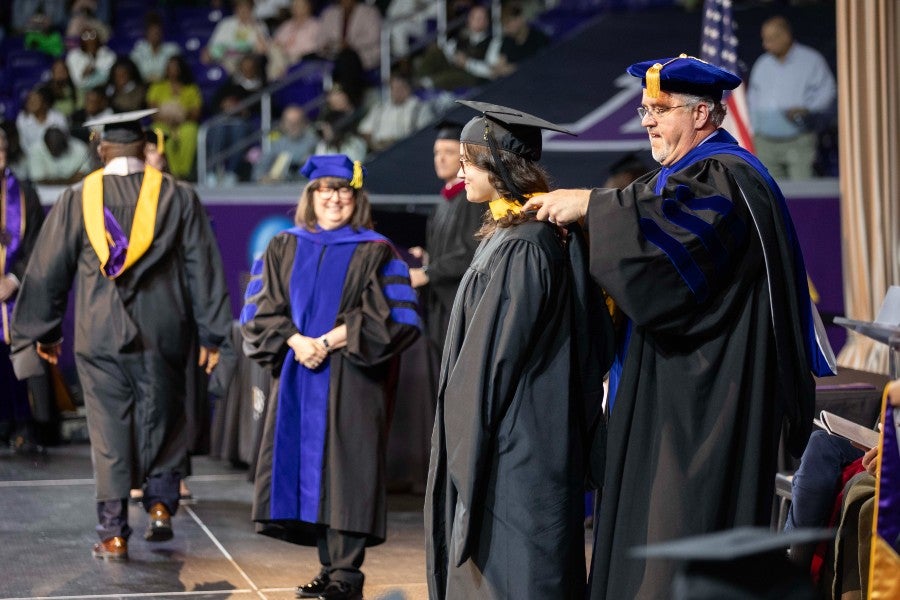
What if a chemistry exam could ask follow-up questions? That's the idea behind the capstone project of Joy Osipchuk (BS '24, MS '26) (pictured above), Dr. Matt Vergne (MS '26), and Dr. John Smith (MS '26), three graduates of the first cohort of Lipscomb's Applied AI master's program. Their AI-driven oral examiner conducts individualized Socratic dialogues with students, assessing not just what they memorized but also probing their reasoning, conceptual understanding and problem-solving skills. Because the AI tool tailors each conversation to each student, the format sidesteps many of the vulnerabilities of conventional written tests, such as surface-level assessment and the inability to probe or follow up on questions.