Becoming Philistine: Rethinking Origins, Identity and Cultural Change in the Iron Age
Tuesday, October 6, 2026 5:00 PM
Ezell Center, Paul Rogers Boardroom (room 147)
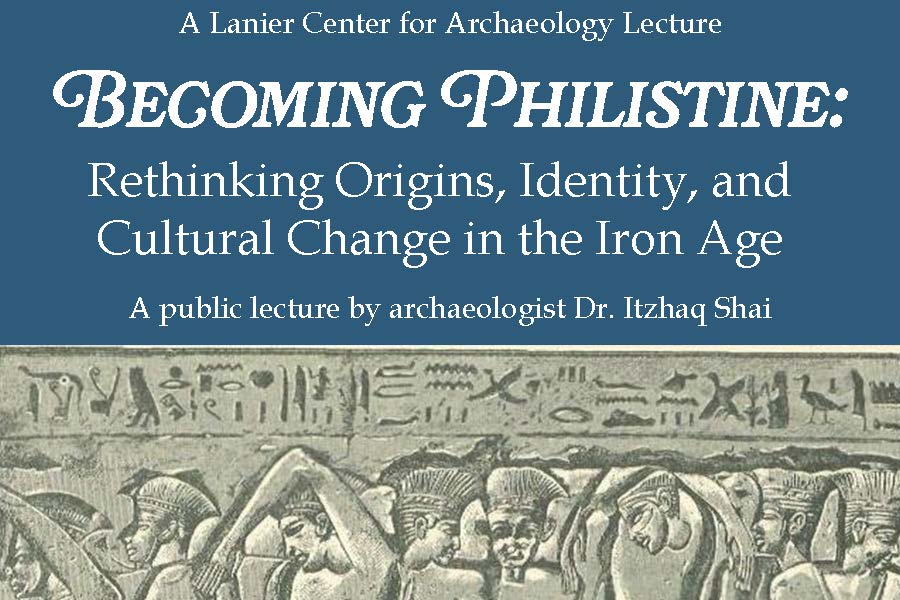
The Lanier Center for Archaeology hosts a public lecture by Prof. Itzhaq Shai, an archaeologist and the director of the Tel Burna Archaeological Project and the Tel Ashdod Excavation Project, both excavation sites where the Lanier Center has been involved.
Few peoples of the ancient Near East have attracted as much attention as the Philistines. For much of the twentieth century, research focused primarily on their origins: Were the Philistines among the "Sea Peoples"? Where did they come from? And to what extent could Aegean-style pottery and other elements of material culture be used to trace their migration to the southern Levant?
Over the past several decades, however, this discussion has changed substantially. Extensive excavations and final publications from major Philistine cities—particularly Ashkelon, Ekron and Gath—together with developments in archaeological science, including ancient DNA research, have produced a far more complex picture. Migration and connections with the western Mediterranean remain important parts of the story, but they are only its beginning. Increasingly, the Philistines can be understood not as a homogenous population carrying a fixed cultural package into the Levant, but as communities whose identities developed through continuing interaction among newcomers, local populations, neighboring societies and the wider Mediterranean world.
This lecture traces this changing understanding of Philistine origins, culture and identity from the 12th through the seventh centuries BCE. It asks not only where the Philistines came from, but how people became—and remained—Philistine as their cities and communities changed over the course of the Iron Age.
Against this background, the lecture concludes by turning to one of the five major Philistine cities: Ashdod. In light of what has been learned at Ashkelon, Ekron and Gath, renewed excavation at Tel Ashdod offers an exceptional opportunity to test emerging models of Philistine diversity, cultural transformation and regional interaction—and to ask what another major Philistine city may contribute to the next chapter in the study of the Philistines.
About Itzhaq Shai
Shai's research focuses on the Bronze and Iron Ages in the Southern Levant. He completed his Ph.D. at Bar Ilan University and a postdoctoral fellowship at the Semitic Museum of Harvard University. Prof. Shai was a research fellow in the School of Advanced Studies at the Hebrew University and taught at Bar-Ilan University and Yellin Education College. He joined Ariel University in 2012 as a senior lecturer and in 2015 established the newest institute of archaeology in Israel. From 2018-2020, Prof. Shai was the Vice Dean of R&D at Ariel University. He is the editor of two books and has published dozens of articles in peer-reviewed journals. Since October 1, 2020, he has been the Vice President and Dean for R&D at Ariel University.
This lecture is free and open to the public.