Reflecting on the Peugeot Center’s Work
May 20, 2026
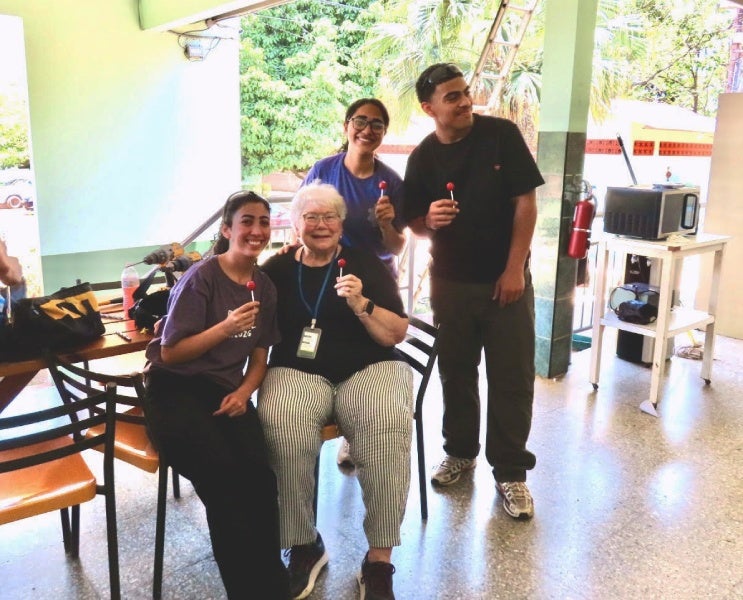
Mary Ann’s Perspective
This is a different kind of blog from what you’ve been seeing from this trip because it’s more of a reflection of the past and heavily influenced by what I have heard over the years from students, faculty, and other professionals about the work of the Peugeot Center (PC), even before it became the PC. This is my first-ever engineering mission trip, and this is the trip of a lifetime. At long last, I am getting to experience the camaraderie, teaching, weather, engineering work, and comments from those being served about the work on this trip, as well as the projects from the past. In addition to being present for the work here at Predisan, I have been able to travel to other sites where projects have been done in the past.
After a very long travel day on Sunday, our team met at Predisan on Monday morning for orientation. We toured the facility with an emphasis on our project, what it entailed, and the locations for the work. We then had an intensive from Dean Elrod on the details for the project. His instruction was detailed, in-depth, and thorough as to the work to be done. Since this is a project never before attempted by the PC, the exact procedures on how to accomplish the tasks were not as well defined as before. The raw materials were there, but what were the best ways to accomplish the tasks at hand? It was fascinating to me to see how the team members came together to figure out how to make it all work and then to arrive at even more efficient ways to save valuable time and resources. They were thinking outside the box and using their individual skills and teamwork to arrive at ways to accomplish the job at hand and incorporate each other’s suggestions to do things more efficiently. The results of the initial tasks accomplished even that first day were a testament to their eagerness to come together as a team to focus on the project and do it more efficiently.
On Tuesday, David Bass, Nuria Varnau, and I traveled to Honduras Outreach International (HOI) to tour the property and see the projects done by the PC at that location. We traveled in a Predisan truck and were therefore never stopped at any of the police roadblocks along the way. But, evidently, the cows, goats, and horses along the way didn’t get the message because they did block our way momentarily. We also learned very quickly that Nashville is not the only place with speed bumps to slow down traffic since the roads are loaded with them every few miles, even on the open road with nothing to warn drivers they were there—and it was the same on the 6-hour drive from the airport on Sunday! I will also mention that the roads were extremely curvy with hairpin curves to rival or even surpass the Tail of the Dragon in Tennessee and North Carolina. Crazy!! At last, we arrived at HOI with the first sight of the bridge over the highway, which was constructed several years ago by the PC to connect the elementary school to the high school for the students’ safety.
A few miles later, we turned into the main entrance of HOI and were greeted by the sight of the new clinic being built where our team installed solar panels in March 2026. These represented two of the ways that the PC has been a part of HOI’s history. Thanks to my “chance meeting” (arranged by God, I think) with Camila Reina (HOI’s CEO) as my seatmate on the flight from Miami to Honduras on Sunday, I had a 2 1/2 hour orientation on HOI’s programs as well as what the PC trips had meant to HOI over the years. HOI is an amazing organization with multiple programs focused on education, agriculture, healthcare, discipleship, and community development. They are extremely focused on instilling values and teaching people how to do things rather than just supplying their physical needs. It’s the “Teach them how to fish rather than giving them fish to eat” philosophy. They have a large egg production facility focused on fighting child malnutrition by producing and providing eggs to children and families for the first 1,000 days of life. They also have a large dairy production, which is one of the two local milk sources for the region.
Their students are all on scholarship and are educated beyond just reading, writing, and arithmetic. They have an art program, and most children there had never held a brush before. They have computer and guitar classes as well as agriculture classes where they learn how to grow, preserve, and sell the agricultural products. The classrooms are all beautifully decorated with colorful murals that are representative of the children’s ages or the subjects being taught. There are signs everywhere teaching values, etiquette, arithmetic, and other things contributing to a full education.
The only negative to the whole HOI experience was that we walked almost 7,000 steps in 99°F heat. I was very thankful for a large, wide-brimmed hat, but it still didn’t help that much.
Wednesday brought the opportunity to visit Predisan’s Center for Community Development (CEDECO) as well as other programs that are a part of Predisan’s work in and for the community. CEDECO is where much of the initial work of the PC (both before and after it was named the PC) happened. It sometimes provides the starting point for some of the work that was and is more distant and rustic because the area is very mountainous. The roads in the area provided another opportunity to experience speed bumps—the regular kind, plus the addition of several that resembled orange or grapefruit halves. Ugh! We again experienced the dramatic S-curves like those the day before, but this time on chert roads (similar to clay mixed with dirt), which were extremely bumpy and with large holes. In fact, this was the first time in my life I’ve seen a driver roll down the window to check the hole in the road to figure out whether to keep going.
Our first visit was to one of many community pharmacies where a small inventory of useful drugs is stocked at a person’s home so that anyone who needs something can access it quickly and for free.
Our next stop was a one-room school also maintained by Predisan. This school had children in grades 1–6, and they were all in the same room because only one teacher was available. A meal is provided at lunch, cooked by mothers who prepare it on a wood stove outside. Children get here however they can before their starting time of 7:00 AM, with some of them walking 2 miles to get there. (This was starkly different from the school at HOI and somewhat upsetting.) After leaving there, the driver was kind enough to take us to one of the clinics formerly run by Predisan, which has been taken over by the Honduran government. This clinic still had one of the antennas left from the time that the clinic communicated with Predisan via marine bank radios. Actually, the marine band radio receiver was still mounted on the wall, so that was interesting for me to see due to the history with the PC. (Explanation coming later!)
We finally made it to CEDECO itself. This was the location of the first Lipscomb engineering mission trip, where the participants responded to a need for water and built a large water tower, which is still standing.
Several buildings are located on this property, one of which houses a large room dedicated to educational pursuits. We talked with the lady in charge about how the room is used as a classroom/audiovisual room/library/internet/research facility, where teachers or students can come to do research or hold gatherings. This room is adjacent to a very large room when larger spaces are needed for such occurrences as medical clinics, such as the one sponsored by Predisan two years ago, when Dr. Nuria Varnau served with her husband. It was in exploring this room that I was surprised and delighted to find multiple pictures and posters commemorating the erection of a radio repeater tower (El Loro = The Parrot) in 2011, which enabled Predisan to communicate directly with all their outlying mountain clinics. Before that time, patients who needed life-saving drugs or were in difficult situations had their lives jeopardized due to the inability to communicate directly with Predisan to get what was needed quickly. Our driver shared that this event signified the beginning of a new era for Predisan to be able to serve the outlying communities. Since this was a project that my husband worked on and was here to install, along with several students and faculty that I remember well, this was a very special moment for me.
The trip to CEDECO ended my outside tours of the many projects of the PC in and around Catacamas. Those provided insights into some of the past projects and clarified and solidified many of the stories shared by students over the years. As much as I have enjoyed my journey into the past this week, what I have been most impressed with this week has been the phenomenal work done by the students, the Dean, and other professionals on this trip. This installation is the first of its kind attempted by the PC, and it has been a phenomenal demonstration of painstaking preparation, execution, and selfless teamwork by a diverse group of individuals who have never worked together before. These men and women have been dedicated to service and making a difference in the lives of others. Each has used his/her God-given talents to do whatever was needed to supply oxygen to patients who need it and to help medical providers with the tools to provide for those in their care. What I have observed is a priceless demonstration of love, teamwork, talent, and selfless contributions of energy to provide something to a medical facility and staff who thought this project was beyond their reach. As for myself, I am intensely grateful for this opportunity to travel with this group and be a part of something that is much bigger than we can imagine. Heartfelt thanks to Dean Elrod, Allyanna, Daniela, Mariam, Mariz, Mark, Juan, Justice, R’Mani, Dan, David, and Nuria for including me in this journey! Blessings on you all!
I love you!
— Mary Ann
Not a Trip
Category: Student Life