First Parker Society awardee studies in France
Kaela Abbate researches the role of women in the French Resistance during World War II in Caen, France.
By Janel-Shoun-Smith | 615-335-6273 |
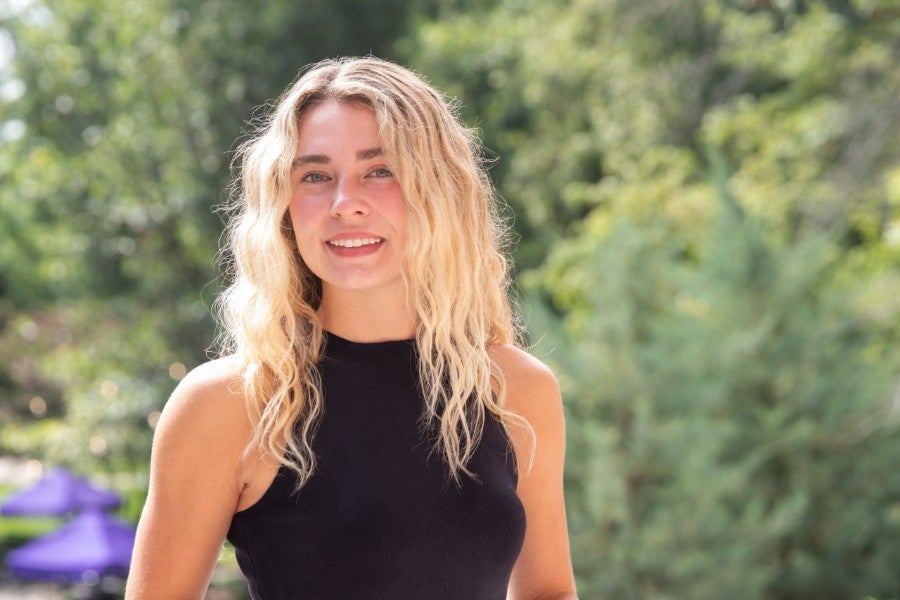
Kaela Abbate (left) is the inaugural recipient of the Parker Humanities Research Award, presented by the Dr. John Parker Humanities Society, coordinated by David Holmes (right).
This story was updated on 8/11/2026.
Kaela Abbate, a rising senior history major from Thompson’s Station, is the inaugural recipient of the first Parker Humanities Research Award, which supports students in English, history or philosophy who require funding for travel related to conferences or research.
Abbate, who also minors in French and is on track to graduate in three years, is studying the role of women in the French Resistance during World War II, through research trips to Caen, France. Her paper, to be completed in spring 2027, will pay particular attention to women’s contributions surrounding the D-Day invasion as couriers, spies and radio operators.
The Dr. John Parker Humanities Society, an alumni and donor affinity group, was established last year to nurture academic and spiritual growth in students in English, history and philosophy by providing resources for research, mentorship and personal development.

David Holmes
“The society aspires to form a vibrant community of scholars, alumni and faculty with commitment to humanities students,” said David Holmes, director of the society, “thus creating an enriched environment for intellectual exploration, preparing students for various career paths.”
Inspired by The Nightingale, a 2015 historical fiction novel by Kristin Hannah, Abbate chose to write about women’s resistance to the Vichy French government during WWII and found herself deeply moved by the personal testimonies of the women involved. Upon completion, her professor encouraged her to use the topic for her senior thesis, said Abbate.
Having already visited France in the eighth grade with her family and hearing stories of her mother’s multiple visits to France, Abbate says she already loved French culture, and the thesis topic spurred her to begin planning her own research trip to France.
Through that planning, Professor of French Kelly Kidder, Abbate’s faculty mentor for the project, introduced Abbate to the Université Catholique de L’Ouest’s three-week study abroad program in the Centre International d'Études Française in Angers, France, and recommended her proposal for the Parker grant.
During her studies at the centre, Abbate took a trip to Sword Beach at Normandy, where she learned about women’s involvement with the D-Day invasion as couriers, spies and radio operators.
The Parker grant funded a second research trip to Caen, France, where Abbate met a local expert for a four-hour tour specializing in the WWII resistance movement, with stops including the Caen Gestapo headquarters; the Prefecture, the municipal center where French officials had to navigate German policies, and Rue de LaPlace, a location where resistance fighters would obtain fraudulent documents and the site of several arrests, said Abbate.
On the tour, Abbate said she learned about women who worked at the Prefecture as double agents, creating fake official documents or obtaining lists of Jewish people to be arrested and warning them ahead of time. The tour took her along the same route that 11 women during the war drove ambulances to secretly help wounded British soldiers, he said.
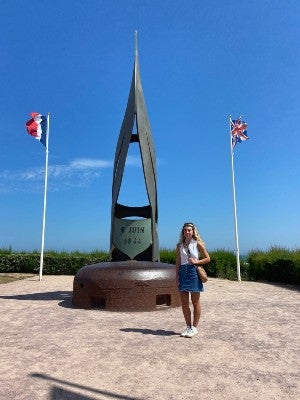
Abbate at Normandy Beach
She also visited the Caen Memorial Museum, which commemorates World War II and the Battle for Caen.
“I took lots of photos, and I gained a great deal of perspective on who these women were and what their daily life was like by seeing where they lived and worked,” said Abbate. “The trip reinforced for me how important oral history is, and it was great to be fully immersed with what I was there to research.”
Her classes at the centre also included a World War II history course and various weekend trips out to historical sites in Angers. To study the war while living in the actual location where events happened was very impactful, said Abbate.
“It gave me goosebumps, even in the middle of the summer heat wave,” she said.
“As I was researching [my first paper], I wanted to highlight what French patriotism looks like,” she said. “It started in the French Revolution in the 1700s. The concept of brotherhood, equality and liberty is rooted in the French identity.
“Ultimately, they really believed in what they were fighting for. They didn’t expect recognition. They did it because they had to, and that is so inspiring,” said Abbate, noting that just recently advocates have succeeded in getting more recognition for women’s accomplishments, such as local streets named for them.
Abbate began learning French in the eighth grade and already harbored a great love for travel. “I love the idea of seeing these places that I have read about and seeing God’s hand working throughout time,” she said.
She is so passionate about French history, she paid for her own plane ticket on her family’s trip to France, earning the money by tutoring her classmates.
She studied in a classical school for her middle school years and Williamson County public high schools until she selected Lipscomb for its close location and Christian community.
She hopes to obtain a teaching position in France after graduation. “I have been really lucky to have teachers who have poured into me and would like to do the same for others,” she said.